30/09/2026
AI in Construction vs Traditional Construction Methods: Jobs, Skills and Career Opportunities
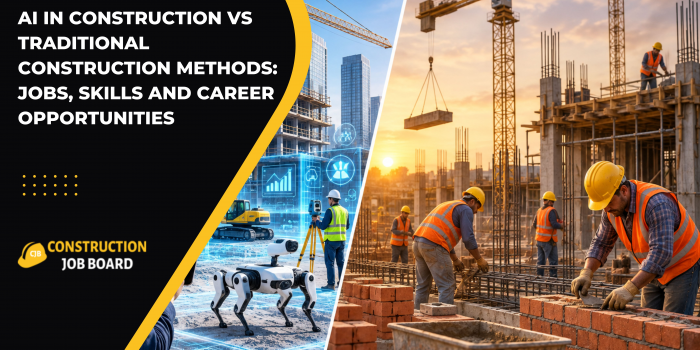
AI in construction vs traditional construction methods is becoming an important comparison for professionals considering how technology is changing construction work in the UK. Artificial intelligence is increasingly being explored for planning, design coordination, risk identification, document analysis, progress monitoring and other construction activities, while traditional construction methods continue to rely heavily on established processes, practical experience and human decision-making.
AI is not replacing every traditional construction process. Instead, many projects are combining established construction knowledge with digital tools. This is creating demand for professionals who understand both the practical requirements of construction and the technology being introduced into the industry.
Direct Answer: How Is AI Changing Construction Compared With Traditional Methods?
Traditional construction methods rely primarily on established construction practices, manual processes, professional experience and conventional project-management systems.
AI-supported construction uses technologies that can analyse data, identify patterns, automate selected tasks and support decision-making.
The difference is therefore not simply AI versus traditional construction. In many cases, the industry is moving toward a combination of:
- Practical construction expertise
- Digital construction systems
- Artificial intelligence
- BIM
- Data analysis
- Automated processes
- Human decision-making
AI can support construction professionals, but project teams still need qualified people to interpret information, make decisions and manage physical construction activities.
What Is Traditional Construction?
Traditional construction involves established methods of designing, planning and building structures using conventional processes and construction expertise.
Depending on the project, traditional workflows can include:
- Manual site inspections
- Paper or spreadsheet-based records
- Conventional surveying
- Physical drawings
- Traditional project meetings
- Manual progress reporting
- Established construction techniques
- Direct site supervision
- Human-led scheduling and decision-making
Traditional construction should not necessarily be interpreted as outdated. Many established methods remain essential because construction ultimately involves physical buildings, infrastructure, materials, equipment and people working on site.
The important distinction is that traditional workflows may involve fewer automated or AI-supported processes.
What Is AI in Construction?
AI in construction refers to the use of artificial intelligence technologies to support activities across the construction lifecycle.
Potential applications include:
- Project planning
- Risk identification
- Document analysis
- Design support
- Progress monitoring
- Safety monitoring
- Predictive analysis
- Resource planning
- Cost analysis
- Schedule analysis
- Information management
Government research into AI skills for the UK workforce identifies construction applications including AI-supported planning, drone-assisted surveying, automated hazard detection and AI-supported retrofit modelling.
The technology is therefore becoming relevant across multiple construction disciplines rather than being limited to specialist technology companies.
AI in Construction vs Traditional Methods: Key Differences
|
Area
|
Traditional Construction
|
AI-Supported Construction
|
|
Planning
|
Human-led planning
|
Planning supported by data and AI tools
|
|
Site monitoring
|
Manual inspections
|
Can include automated monitoring
|
|
Data analysis
|
Manual analysis
|
AI can analyse large datasets
|
|
Risk identification
|
Experience and established processes
|
Data-driven and AI-assisted analysis
|
|
Documentation
|
Manual processing
|
Automated or AI-assisted processing
|
|
Design coordination
|
Traditional coordination
|
Digital models and AI-supported analysis
|
|
Decision-making
|
Primarily human-led
|
Human decisions supported by digital analysis
|
|
Skills
|
Construction expertise
|
Construction + digital and data skills
|
|
Reporting
|
Manual reporting
|
Automated or AI-assisted reporting
|
|
Technology
|
Conventional systems
|
AI, BIM, data and digital platforms
|
AI does not remove the need for construction professionals. Instead, it can change how some professionals perform their existing responsibilities.
Which Construction Jobs Are Being Affected by AI?
AI can potentially influence a wide range of construction roles.
These include:
- Construction Project Managers
- Quantity Surveyors
- Estimators
- Site Managers
- Construction Planners
- BIM Managers
- Architects
- Engineers
- Building Surveyors
- Design Managers
- Health and Safety Professionals
- Commercial Managers
The impact is likely to vary according to the tasks involved in each role.
Jobs involving significant amounts of repetitive information processing may have more opportunities for automation or AI assistance than activities requiring physical work, complex site judgement or direct leadership.
How Can AI Support Construction Project Managers?
Project managers already work with large amounts of project information.
AI tools may help with activities such as:
- Reviewing project documents
- Identifying information patterns
- Summarising reports
- Analysing project data
- Identifying potential schedule risks
- Supporting resource planning
- Organising project information
However, project managers remain responsible for understanding the project context and making appropriate decisions.
An AI-generated recommendation does not replace professional judgement, contractual responsibilities or communication with project stakeholders.
How Can AI Affect Quantity Surveyors?
Quantity surveying involves substantial amounts of commercial information, making it an area where digital tools can potentially provide support.
AI may assist with:
- Document analysis
- Cost data analysis
- Estimating support
- Identifying cost patterns
- Reviewing project information
- Supporting forecasting
Quantity surveyors still need commercial knowledge, construction understanding and the ability to interpret information.
The role therefore may evolve toward greater use of data and digital tools rather than disappearing because of AI.
How Can AI Support Construction Planners?
Construction planning is another area where data analysis can be useful.
AI-supported tools may assist with:
- Schedule analysis
- Activity sequencing
- Delay identification
- Resource planning
- Progress analysis
- Risk identification
- Scenario analysis
Construction planners still need to understand how construction activities work in practice.
A schedule can only be useful if it reflects realistic construction processes, resource availability and site conditions.
Is AI Replacing Construction Workers?
AI is not a direct replacement for all construction work.
Many construction activities require physical skills, site experience, coordination, safety awareness and practical judgement.
Trades and site-based roles such as:
- Bricklayers
- Carpenters
- Electricians
- Plumbers
- Roofers
- Plant operators
- Groundworkers
involve physical tasks that cannot simply be transferred to software.
However, digital technology can change the way these workers receive information, record progress, coordinate activities and interact with project teams.
Which Skills Are Becoming More Important?
The increasing use of AI creates demand for a combination of traditional construction knowledge and digital capability.
Important skills can include:
Digital Literacy
Construction professionals increasingly need to understand the digital systems used by their employers and projects.
Data Literacy
Understanding basic project data can help professionals interpret information produced by digital systems.
Construction Knowledge
AI tools still depend on accurate project information and professional interpretation.
Critical Thinking
Professionals need to assess whether AI-generated information is appropriate for the project.
Communication
Technology does not remove the need for communication between project teams.
Adaptability
Construction technology continues to change, making the ability to learn new systems increasingly useful.
AI Skills vs Traditional Construction Skills
The construction workforce does not necessarily need to choose between technical construction skills and AI skills.
The two can complement each other.
For example:
Construction Planner + Data Skills
can combine practical scheduling knowledge with digital analysis.
Quantity Surveyor + AI Tools
can combine commercial expertise with automated information processing.
BIM Manager + AI
can combine information-management expertise with advanced digital analysis.
Site Manager + Digital Reporting
can combine site experience with digital progress monitoring.
This combination can help construction professionals understand both the physical and digital sides of modern project delivery.
How Is AI Affecting BIM?
BIM already provides structured digital information about construction projects.
AI can potentially analyse BIM-related information and support activities such as:
- Model analysis
- Design coordination
- Clash identification
- Construction sequencing
- Information classification
- Building performance analysis
The combination of BIM and AI could therefore create new responsibilities for digital construction professionals.
However, BIM and AI are not the same thing.
BIM is primarily concerned with structured digital information and information management, while AI refers to technologies capable of performing tasks involving analysis, pattern recognition or other forms of computational intelligence.
What Does This Mean for Construction Careers?
Construction careers are increasingly combining traditional expertise with digital skills.
A candidate applying for a modern construction role may therefore benefit from demonstrating both:
Industry knowledge
and
Technology awareness.
For example, a Project Manager who understands BIM, digital reporting and AI-supported project tools may be able to work more effectively with digital project teams.
Similarly, a BIM professional who understands construction processes can better appreciate how digital information is used on actual projects.
What Should Construction Professionals Learn About AI?
Construction professionals do not necessarily need to become AI developers.
For many roles, a practical understanding of AI may be more relevant.
Professionals can develop knowledge of:
- AI terminology
- Generative AI
- Data analysis
- AI-assisted reporting
- Prompting
- Digital project-management systems
- BIM and information management
- Data security
- AI limitations
- Human verification of AI-generated information
The appropriate level depends on the individual's role.
A construction manager may need to understand how AI affects project delivery, while a technology specialist may need deeper technical knowledge.
What Are the Risks of Using AI in Construction?
AI can provide useful support, but construction organisations also need to consider potential risks.
These can include:
- Incorrect outputs
- Poor-quality data
- Data security
- Confidential project information
- Lack of human verification
- Inappropriate automation
- Bias in datasets
- Over-reliance on technology
Construction decisions can have significant financial, safety and contractual consequences.
For this reason, AI-generated information should be appropriately reviewed before being used for important project decisions.
Will Traditional Construction Skills Still Matter?
Yes.
Construction remains a physical industry requiring practical expertise.
Professionals will continue to need knowledge of:
- Construction methods
- Materials
- Site operations
- Health and safety
- Building regulations
- Project coordination
- Engineering principles
- Quality control
- Trade skills
Technology can change how these skills are applied, but it does not eliminate the physical requirements of constructing and maintaining buildings and infrastructure.
How Should Candidates Adapt Their Construction CVs?
Candidates can demonstrate their ability to work with both traditional construction processes and digital tools.
For example, candidates can highlight:
- BIM experience
- Digital project-management systems
- Construction software
- Data analysis
- Digital reporting
- AI tools used appropriately
- Construction planning
- Project coordination
- Site experience
- Technical qualifications
Instead of simply writing "AI skills," candidates should explain how technology was used in a real project or work environment.
What Construction Employers May Look for in Future Candidates
Requirements vary between employers, but construction roles increasingly combine technical and digital capabilities.
Employers may value candidates who can:
- Understand construction processes
- Use relevant digital systems
- Interpret project data
- Communicate across technical teams
- Adapt to new technology
- Identify technology limitations
- Maintain professional standards
- Apply human judgement
The combination of construction expertise and digital capability can therefore become increasingly relevant across different career paths.
Key Takeaways
- AI is changing selected construction processes but does not eliminate the need for construction professionals.
- Traditional construction skills remain essential for physical project delivery.
- AI can support planning, document analysis, risk identification, reporting and other activities.
- BIM and AI are different technologies but can work together.
- Construction professionals can benefit from combining industry expertise with digital and data skills.
- AI literacy does not necessarily mean becoming an AI developer.
- Human judgement remains important when using AI for construction decisions.
- Candidates can strengthen their CVs by demonstrating practical digital skills alongside construction experience.
Frequently Asked Questions
1. Is AI replacing construction jobs?
AI is more likely to change some construction tasks and workflows than replace every construction job. Physical construction, site supervision, technical judgement and many professional responsibilities continue to require human expertise.
2. How is AI being used in construction?
AI can support activities such as planning, document analysis, risk identification, progress monitoring, data analysis, design coordination and reporting.
3. What construction jobs use AI?
AI can potentially support Project Managers, Quantity Surveyors, Estimators, Construction Planners, BIM Managers, Engineers, Surveyors and other construction professionals. The specific applications vary by employer and project.
4. Do construction workers need AI skills?
Not every construction worker needs advanced AI skills. However, basic digital literacy and awareness of technologies used on construction projects can increasingly be useful.
5. Will traditional construction skills remain important?
Yes. Construction requires practical knowledge, physical skills, site experience, safety awareness and professional judgement. Digital technology can complement these capabilities rather than remove the need for them.
Conclusion
AI in construction is changing how some projects are planned, monitored and managed, but it is not simply replacing traditional construction methods.
The emerging construction workplace is more likely to combine established construction expertise with digital systems, BIM, data and artificial intelligence. Project Managers, Quantity Surveyors, Planners, BIM professionals, Engineers and Site Managers can increasingly encounter technology as part of their normal workflows.
For construction professionals, developing digital awareness alongside practical industry knowledge can provide a way to adapt to changing project environments. The level of AI knowledge required will depend on the role, employer and type of construction project.
The most important distinction is that AI is a tool within construction rather than a substitute for the entire construction workforce. Buildings and infrastructure still require people with the skills to design, plan, manage, build, inspect and maintain them.