26/08/2026
Why Does the UK Need So Many Construction Workers?
Why does the UK need so many construction workers when the industry already employs millions of people?
The answer is more complicated than simply saying there are not enough workers.
The UK's construction workforce is being pulled in several directions at the same time. The country needs new homes, transport infrastructure, energy projects, commercial buildings and improvements to existing properties. At the same time, experienced workers are reaching retirement, employers need new technical skills, and the industry is changing through digitalisation and low-carbon construction.
Government evidence highlights the scale of the challenge. A 2026 government consultation notes that the CITB has forecast a potential need for around 240,000 additional UK construction workers by 2030. It also notes that construction vacancies had fallen year-on-year in early 2026, demonstrating that workforce demand and short-term economic conditions do not always move in the same direction.
This distinction is important.
The UK does not simply need “more people”.
It needs the right people, with the right skills, in the right locations, at the right time.
Why does the UK need more construction workers?
The biggest reason is the amount of work the UK needs to deliver and maintain.
Construction is responsible for much more than building new houses.
The industry supports:
- Residential development
- Commercial buildings
- Roads
- Railways
- Utilities
- Energy infrastructure
- Schools
- Hospitals
- Industrial facilities
- Refurbishment
- Building maintenance
- Retrofit
- Environmental improvements
Every one of these activities requires people with different skills.
A housebuilding project might need bricklayers, carpenters, electricians, plumbers, groundworkers and site managers.
A major infrastructure project may require civil engineers, surveyors, plant operators, project managers, quantity surveyors and specialist contractors.
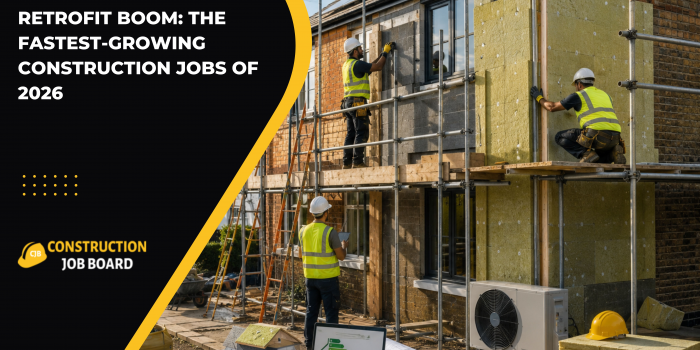
A building retrofit project may require insulation installers, heating engineers, electricians, surveyors and retrofit professionals.
The workforce requirement therefore comes from the breadth of construction activity, not one single project or policy.
Is the UK construction workforce actually shrinking?
The situation is more nuanced than a simple increase or decrease.
Construction employment can rise or fall depending on economic conditions, project starts, investment and employer confidence.
The government reported around 28,000 construction-sector job vacancies in the three months to January 2026, which was lower than the same period a year earlier. At the same time, longer-term workforce forecasts point towards substantial additional demand.
This apparent contradiction is important.
A construction company may reduce recruitment when projects slow down, even though the industry could still face a long-term shortage of skilled workers.
In other words:
Short-term vacancies are not the same thing as long-term workforce requirements.
This is one reason construction jobseekers should look beyond today's vacancy numbers.
Why are experienced construction workers retiring?
One of the UK's biggest workforce challenges is demographic.
Many experienced construction professionals and tradespeople are approaching retirement age.
That creates two problems.
First, the industry loses people with years of practical experience.
Second, new workers need to enter the industry quickly enough to replace those leaving.
Replacing an experienced worker is not always as simple as recruiting another person.
A highly experienced site manager, electrician, bricklayer or engineer may have developed knowledge that comes from years of working on different projects.
That experience can include:
- Problem-solving
- Safety awareness
- Technical judgement
- Understanding site conditions
- Managing subcontractors
- Identifying potential delays
- Working with difficult materials
- Communicating with clients and teams
Training new workers is therefore essential, but it takes time.
Why can't apprenticeships solve the construction workforce shortage immediately?
Apprenticeships are an important part of the solution, but they cannot instantly replace an experienced workforce.
An apprentice needs time to develop practical competence.
Depending on the occupation and programme, training can take years rather than months.
During this period, apprentices need:
- Workplace experience
- Supervision
- Technical training
- Assessment
- Safety knowledge
- Industry qualifications
This creates an important workforce cycle.
Experienced workers → supervisors → apprentices → qualified workers
If too few experienced workers remain to train and supervise new entrants, workforce development becomes more difficult.
That is why retaining experienced professionals and attracting new entrants need to happen together.
Is housing increasing demand for construction workers?
Yes.
Housing is one of the clearest sources of future construction demand.
The UK needs additional housing because of population changes, household formation, affordability pressures and regional demand.
New homes require a large supply chain.
Before someone moves into a completed house, numerous professionals may have been involved.
These can include:
- Architects
- Planners
- Surveyors
- Engineers
- Groundworkers
- Bricklayers
- Carpenters
- Roofers
- Electricians
- Plumbers
- Plasterers
- Decorators
- Site managers
- Quantity surveyors
Therefore, a housing programme does not create only “housebuilding jobs”.
It supports a much wider construction ecosystem.
Why does infrastructure create so many construction jobs?
Infrastructure projects are often large, complex and long-term.
They can involve:
- Roads
- Rail
- Bridges
- Tunnels
- Airports
- Energy networks
- Water systems
- Utilities
- Digital infrastructure
A major project may employ different workers at different stages.
For example, early phases may require surveyors, engineers and planners.
Groundworks may then create demand for plant operators, groundworkers and site engineers.
Later stages can require electricians, mechanical specialists, installers and finishing trades.
Project management, commercial management and health and safety roles can continue throughout the project lifecycle.
This creates demand across a wide range of occupations.
Could infrastructure investment create construction jobs outside London?
Absolutely.
Construction demand is geographically distributed.
Major infrastructure projects can stretch across counties and regions rather than being concentrated inside one city.
That means construction workers should not assume that London is the only important employment market.
Regional opportunities can emerge around:
- Transport corridors
- Energy projects
- New housing developments
- Industrial developments
- Regeneration programmes
- Utilities
- Major public-sector projects
For jobseekers, this means monitoring projects and investment, not just cities.
Why is maintenance just as important as new construction?
New buildings attract attention, but existing buildings also require continuous work.
Schools need maintenance.
Hospitals need upgrades.
Offices need refurbishment.
Homes need repairs.
Industrial facilities require maintenance.
Older buildings may require improvements to insulation, heating, ventilation and electrical systems.
This creates a separate source of construction employment.
Maintenance and refurbishment can also provide opportunities when new-build construction slows.
For certain trades, this can make the work particularly resilient.
Is retrofit creating new construction jobs?
Retrofit is becoming increasingly important as the UK seeks to improve the performance of existing buildings.
Retrofit can involve:
- Insulation
- Windows
- Heating systems
- Ventilation
- Solar technologies
- Heat pumps
- Electrical upgrades
- Energy monitoring
These projects require both traditional construction skills and new technical knowledge.
For example, an electrician may increasingly encounter renewable-energy systems.
A heating engineer may need knowledge of low-carbon heating.
A surveyor may need to understand building performance.
This means future construction demand is not simply about more workers.
It is also about new combinations of skills.
Why are construction skills changing?
Construction is becoming more technologically advanced.
Modern projects increasingly use:
- Building Information Modelling
- Digital surveying
- Drones
- Construction management software
- Digital twins
- Automated equipment
- Artificial intelligence
- Off-site manufacturing
Your existing blog already covers the broad impact of AI and robotics on construction jobs, so this new article should focus on a different question: why workforce demand continues even as technology improves productivity.
Technology does not necessarily eliminate the need for construction workers.
Instead, it can change what workers do.
A site professional may increasingly need to interpret digital information.
A surveyor may use advanced scanning equipment.
A project manager may work with AI-supported planning tools.
A skilled tradesperson may interact with automated equipment.
The future workforce therefore needs a mixture of practical, technical and digital skills.
Does automation mean the UK will need fewer construction workers?
Not necessarily.
Automation can reduce the amount of time required for certain repetitive activities.
However, construction projects remain complex.
Buildings are rarely constructed in perfectly controlled environments.
Sites change.
Materials vary.
Weather changes.
Unexpected problems occur.
Clients change requirements.
Designs are revised.
Workers need to make decisions in real-world conditions.
Technology can support these activities, but it does not remove the need for human judgement.
The bigger change may be the type of worker employers need.
Instead of simply asking:
“Can you do this task?”
employers may increasingly ask:
“Can you do this task while working with digital tools and modern construction systems?”
Why does construction need more skilled workers rather than simply more labourers?
The industry's workforce requirement is becoming increasingly specialised.
A project may need hundreds of workers, but not all vacancies are interchangeable.
A bricklayer cannot simply replace an electrical engineer.
A quantity surveyor cannot automatically replace a site supervisor.
A plant operator cannot automatically perform a structural engineer's role.
This creates what economists call a skills mismatch.
There may be people looking for work while employers simultaneously struggle to find people with particular qualifications or experience.
This explains why simply increasing the number of people entering construction does not automatically solve every labour shortage.
Which construction skills could become more valuable?
Demand changes according to project requirements, but workers who combine practical expertise with additional capabilities can become more adaptable.
Potentially valuable areas include:
- Electrical skills
- Mechanical systems
- Civil engineering
- Quantity surveying
- Site management
- Digital construction
- BIM
- Building services
- Retrofit
- Renewable energy
- Health and safety
- Project management
The strongest career strategy is not necessarily to chase every new technology.
It can be more effective to build a strong core construction skill and then add complementary capabilities.
Why does location matter in the construction workforce shortage?
Construction is a physical industry.
A building needs to be constructed at a particular location.
That creates a geographical mismatch.
There may be a shortage of electricians in one region but enough workers in another.
A major infrastructure project may require hundreds of workers temporarily in an area that does not normally have a large construction workforce.
This is why employers sometimes recruit nationally or offer travel and accommodation arrangements.
For jobseekers, geographical flexibility can therefore create additional opportunities.
What does the construction workforce shortage mean for jobseekers?
A workforce shortage can create opportunities, but it does not guarantee employment.
Employers still need people who meet the requirements of specific roles.
Jobseekers can improve their prospects by developing:
- Relevant qualifications
- Practical experience
- Safety awareness
- Trade competence
- Communication skills
- Digital capability
- Site knowledge
For people entering construction, an apprenticeship or structured training route can provide a foundation.
For experienced workers, specialist qualifications can help support progression.
For professionals, digital and sustainability skills can complement existing expertise.
What does the workforce shortage mean for construction employers?
Employers cannot rely indefinitely on recruiting experienced workers from the same limited talent pool.
They increasingly need to think about workforce development.
That can include:
- Apprenticeships
- Training
- Upskilling
- Mentoring
- Retention
- Career progression
- Flexible recruitment
- Better workforce planning
The government's 2026 consultation specifically highlights the difficulty of aligning existing workforce skills with labour-market demand and notes that construction's cyclical nature can make employer investment in skills more difficult.
That is a crucial issue.
Construction employers may need workers tomorrow, but training someone today requires investment before that person becomes fully productive.
Will the UK still need construction workers in the future?
The available evidence strongly suggests that workforce demand will remain significant.
Housing requirements, infrastructure investment, maintenance, energy transition and workforce replacement all create demand.
CITB's forecast of approximately 240,000 additional workers by 2030 is one indication of the scale involved.
But the future workforce will not look exactly like today's workforce.
There is likely to be greater demand for people who understand:
- Digital construction
- Sustainability
- Modern methods of construction
- Advanced building systems
- Data
- Automation
- Energy efficiency
Traditional skills will remain important, but they will increasingly exist alongside new technologies.
What does this mean for the future of UK construction jobs?
The UK's construction workforce challenge is not simply a story about vacancies.
It is a story about replacement, growth, skills and transformation happening simultaneously.
The country needs workers to replace those retiring.
It needs workers to deliver new housing.
It needs workers to maintain existing buildings.
It needs workers for infrastructure and energy projects.
And it needs workers who can adapt to increasingly digital construction environments.
That combination creates a complex but potentially valuable employment market.
For jobseekers, the message is straightforward:
Construction skills remain valuable, but adaptability is becoming equally important.
For employers, the message is equally important:
Recruitment alone will not solve the workforce challenge. Training and retention have to be part of the strategy.
Frequently Asked Questions
Why does the UK need so many construction workers?
The UK needs construction workers to deliver housing, infrastructure, commercial development, maintenance, refurbishment, energy projects and other built-environment work while also replacing workers who are retiring.
How many additional construction workers will the UK need?
The CITB has forecast a potential need for around 240,000 additional UK construction workers by 2030.
Is there currently a construction worker shortage in the UK?
Yes, the UK faces longer-term skills and workforce pressures, although short-term vacancy levels can fluctuate with economic conditions and construction output.
Why are construction workers retiring?
The construction workforce has an ageing component, meaning experienced tradespeople and professionals are reaching retirement and need to be replaced by new entrants.
Is housing creating construction jobs?
Yes. Housing development requires a wide range of workers, including tradespeople, engineers, surveyors, project managers and site management professionals.
Are infrastructure projects creating construction jobs?
Yes. Large infrastructure programmes can create demand for construction, civil engineering, project management, surveying and specialist technical roles.
Will AI replace construction workers?
AI and automation are more likely to change many construction tasks than eliminate the need for the entire construction workforce. Human skills such as judgement, supervision, practical work and problem-solving remain important.
Why is construction struggling to find skilled workers?
Several factors can contribute, including workforce retirements, skills mismatches, changing project requirements, training capacity and the cyclical nature of construction.
What construction skills will be valuable in the future?
Skilled trades, engineering, site management, quantity surveying, digital construction, BIM, retrofit, building services, sustainability and project management are all relevant areas.
Is construction a good career for someone starting today?
Construction can offer career opportunities across trades, engineering, management, surveying, digital construction and other areas. The strongest opportunities depend on qualifications, experience, location and market demand.