24/08/2026
Where Is the UK Construction Industry Growing Fastest?
Where is the UK construction industry growing fastest?
For someone looking for construction jobs UK, this is a more useful question than simply asking whether construction is growing nationally.
Construction demand is not evenly distributed across Britain.
Some areas are experiencing major housing development. Others are benefiting from infrastructure investment, regeneration, energy projects, commercial development or large public-sector programmes.
That means the best location for a construction career can depend heavily on what type of construction work you want to do.
London remains one of Britain's largest construction markets, but cities such as Manchester, Birmingham and Leeds are also important regional centres. Meanwhile, major infrastructure and energy projects are creating employment opportunities beyond the largest cities.
The bigger picture is equally important.
CITB's latest workforce outlook forecasts that the UK construction workforce will need an average of 41,200 additional workers every year between 2026 and 2030.
So where is this demand likely to appear?
Why does construction growth vary across the UK?
Construction activity depends on several factors.
These include:
- Population growth
- Housing demand
- Infrastructure investment
- Business investment
- Government spending
- Regeneration
- Transport projects
- Energy development
- Industrial investment
- Commercial property demand
- Local planning and development pipelines
A city experiencing rapid population growth may need new housing.
A city receiving major transport investment may need civil engineers and infrastructure workers.
An area with older buildings may generate significant refurbishment and maintenance work.
Therefore, there is no single definition of a "construction boom".
Is London still the UK's biggest construction market?
London remains one of the country's most significant construction markets.
Its scale comes from the combination of:
- Housing demand
- Commercial development
- Infrastructure
- Transport
- Public-sector projects
- Office refurbishment
- Major regeneration
- Residential development
The capital also has an unusually broad construction employment ecosystem.
A construction professional in London may find opportunities across:
- Residential construction
- Commercial buildings
- Rail
- Underground infrastructure
- Civil engineering
- Building services
- Fit-out
- Refurbishment
- Property development
This diversity makes London particularly important for experienced construction professionals.
Are construction jobs in London still attractive?
For many professionals, yes.
London can offer a large number of construction employers and projects.
It also has demand across many levels, including:
- Labourers
- Skilled trades
- Site supervisors
- Site managers
- Quantity surveyors
- Project managers
- Civil engineers
- Structural engineers
- Architects
- Building services engineers
However, London also has higher living costs than many UK locations.
Jobseekers therefore need to compare salary with accommodation, travel and other expenses rather than looking only at the advertised pay.
Is Manchester becoming a major UK construction hub?
Manchester has developed into one of the UK's most important regional construction markets.
The wider Greater Manchester region has experienced substantial development across:
- Residential property
- Commercial buildings
- Transport
- Regeneration
- Education
- Healthcare
- Infrastructure
The city has also benefited from long-term investment and urban regeneration.
For construction professionals, Manchester can therefore offer a different opportunity from London.
It combines major-city projects with a large regional development pipeline.
Why is Manchester important for construction jobs?
Manchester's growth has increased demand for people involved in:
- Residential development
- Commercial construction
- Civil engineering
- Building services
- Property development
- Project management
- Quantity surveying
- Site management
The wider Greater Manchester economy also means construction opportunities are not necessarily concentrated in Manchester city centre.
Nearby areas can benefit from development and infrastructure investment as well.
Is Birmingham one of the UK's strongest construction markets?
Birmingham is another major construction centre.
As the largest city in the West Midlands, Birmingham plays an important role in regional development.
Construction activity can be linked to:
- Housing
- Commercial development
- Transport
- Regeneration
- Education
- Healthcare
- Infrastructure
The city's central location also makes the wider West Midlands important for logistics, manufacturing and industrial development.
This creates opportunities across both building construction and civil engineering.
Why is the West Midlands important for construction?
The West Midlands has a broad economic base.
It includes:
- Birmingham
- Coventry
- Wolverhampton
- Solihull
- Dudley
- Walsall
- Sandwell
This creates a large regional market rather than a single-city construction economy.
Construction workers can therefore consider opportunities across the wider region instead of restricting their search to Birmingham alone.
Is Leeds becoming a construction hotspot?
Leeds is one of the UK's most important cities outside London and the South East.
The wider Leeds City Region has experienced development across:
- Residential property
- Offices
- Education
- Healthcare
- Infrastructure
- Regeneration
- Industrial development
This creates demand for both construction trades and professional roles.
Leeds can therefore be particularly interesting for people looking for opportunities in Yorkshire.
Why is Yorkshire important for construction?
Yorkshire has several significant urban centres, including:
- Leeds
- Sheffield
- Bradford
- York
- Hull
Each has different construction requirements.
Leeds has a strong commercial and professional-services economy.
Sheffield has opportunities linked to regeneration, housing, manufacturing and infrastructure.
Hull has connections to energy and industrial activity.
This illustrates why construction jobseekers should consider regional clusters, not just individual cities.
Is Liverpool experiencing construction growth?
Liverpool remains an important construction and regeneration market.
Its development activity includes:
- Residential projects
- Commercial property
- Regeneration
- Education
- Healthcare
- Infrastructure
- Waterfront development
The wider Liverpool City Region also has strategic importance for transport, logistics and industry.
That creates opportunities beyond traditional building construction.
Could Newcastle and the North East offer construction opportunities?
Yes.
The North East has a growing interest in regeneration, infrastructure, energy and advanced manufacturing.
Cities and areas including:
- Newcastle
- Sunderland
- Gateshead
- Durham
can provide construction opportunities associated with both public and private investment.
The region is also relevant to emerging energy and industrial projects.
For workers with engineering or infrastructure skills, these markets can be worth monitoring.
Are construction opportunities concentrated only in England?
No.
Scotland, Wales and Northern Ireland also have substantial construction markets.
Scotland has important activity across:
- Housing
- Infrastructure
- Renewable energy
- Transport
- Commercial development
- Public buildings
Cities such as Edinburgh and Glasgow remain important employment centres.
Wales has construction demand linked to housing, infrastructure, public buildings and energy.
Northern Ireland also has ongoing demand across housing, infrastructure and commercial development.
Therefore, the UK construction job market should not be viewed only through an English-city lens.
Which UK cities have the most construction jobs?
There is no reliable single ranking that can permanently identify the "best" construction city.
Job availability changes according to:
- Project starts
- Economic conditions
- Planning approvals
- Infrastructure programmes
- Contractor demand
- Local labour supply
However, major employment centres commonly include:
London
Manchester
Birmingham
Leeds
Liverpool
Glasgow
Edinburgh
Bristol
Sheffield
Newcastle
These cities should be viewed as major construction markets rather than guaranteed sources of the most vacancies at any particular moment.
Is Bristol a good city for construction careers?
Bristol is an important construction and engineering centre in the South West.
The wider region benefits from:
- Residential development
- Infrastructure
- Commercial construction
- Engineering
- Aerospace-related activity
- Regeneration
Bristol can therefore be particularly interesting for professionals who combine construction with engineering or technical expertise.
Are construction jobs growing outside major cities?
Yes.
Some of the UK's most important construction projects are not located inside city centres.
Infrastructure projects can extend across:
- Counties
- Transport corridors
- Coastal areas
- Rural locations
- Industrial zones
Energy projects are another example.
Wind farms, power infrastructure, grid upgrades and other developments can require construction workers across geographically dispersed locations.
This means searching only for "construction jobs London" or "construction jobs Manchester" can cause jobseekers to miss opportunities.
Are infrastructure projects changing where construction jobs are available?
Yes.
The UK's infrastructure pipeline is geographically much broader than the biggest cities.
The government reported in 2026 that its infrastructure pipeline contained 734 projects representing approximately £718 billion of public and private investment over the next decade.
These projects cover areas including:
- Transport
- Energy
- Utilities
- Digital infrastructure
Infrastructure therefore creates construction employment across multiple regions.
Which construction sectors are growing fastest?
The strongest opportunities can differ by region.
Housing can drive demand for:
- Bricklayers
- Carpenters
- Electricians
- Plumbers
- Roofers
- Groundworkers
Infrastructure can create demand for:
- Civil engineers
- Site engineers
- Groundworkers
- Plant operators
- Quantity surveyors
- Project managers
Commercial construction can create demand for:
- Building services engineers
- Project managers
- Surveyors
- Fit-out specialists
Energy projects can require:
- Engineers
- Electricians
- Project managers
- Construction managers
- Specialist technicians
The most useful question for jobseekers is therefore:
Which sector is growing in the area where I want to work?
Is housing driving UK construction growth?
Housing is one of the most important sources of construction demand.
The UK government has an ambition to deliver 1.5 million new homes during the current Parliament.
CITB's latest workforce forecast identifies both public and private new housing as important areas of construction growth through 2030.
Housing demand creates employment throughout the construction supply chain.
That includes:
- Housebuilders
- Main contractors
- Subcontractors
- Skilled trades
- Surveyors
- Engineers
- Architects
- Construction managers
Which construction workers benefit from housing growth?
Housing development requires a broad workforce.
Examples include:
Bricklayers
Responsible for structural and external masonry work.
Carpenters
Involved in structural timber, roofing and finishing work.
Electricians
Install electrical systems and services.
Plumbers
Install water, heating and plumbing systems.
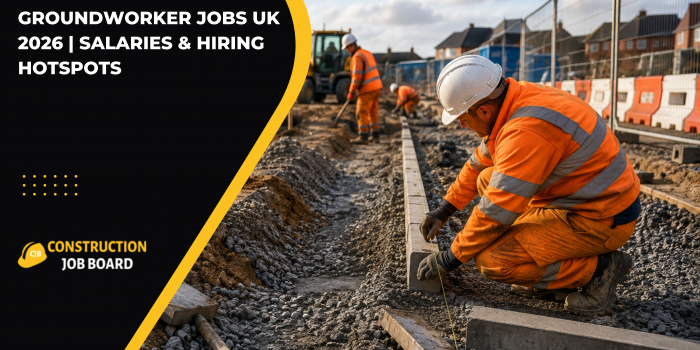
Groundworkers
Prepare sites and install foundations, drainage and infrastructure.
Quantity Surveyors
Manage costs, procurement and commercial aspects of projects.
Site Managers
Coordinate construction activities, workers, safety and programme delivery.
This is why housing investment can generate jobs far beyond housebuilding companies themselves.
Is repair and maintenance important for construction growth?
Yes.
New construction receives a lot of attention, but repair and maintenance represents a major part of the UK construction market.
CITB's latest workforce outlook estimates that repair and maintenance accounted for approximately 41% of total construction output in 2025.
That is important for jobseekers because maintenance demand is not entirely dependent on new development.
Existing buildings always need:
- Repairs
- Refurbishment
- Roofing
- Electrical work
- Plumbing
- Heating
- Insulation
- Maintenance
This can create a more diverse construction employment market.
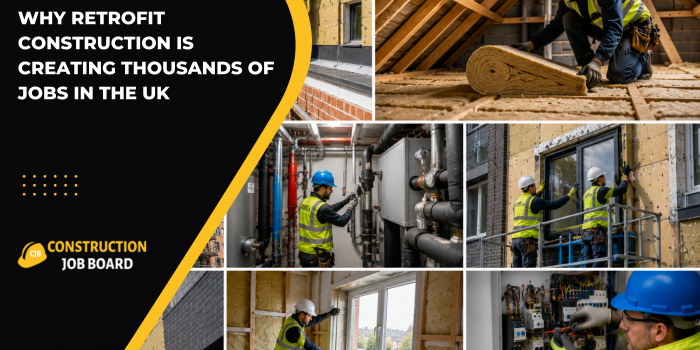
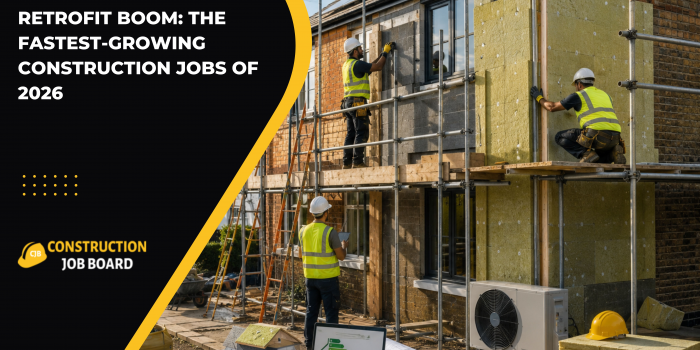
Could retrofit create construction jobs across the UK?
Yes.
Retrofitting existing buildings can require:
- Insulation installers
- Electricians
- Heating specialists
- Plumbers
- Roofers
- Surveyors
- Energy assessors
- Project managers
As energy efficiency becomes increasingly important, retrofit may become a more significant source of construction work.
This could be particularly relevant in areas with large stocks of older residential and commercial buildings.
Is green construction creating new opportunities?
The construction industry is increasingly connected to sustainability.
Future projects can involve:
- Energy-efficient buildings
- Low-carbon materials
- Renewable energy
- Building retrofit
- Sustainable infrastructure
- Waste reduction
- Energy management
This creates demand for workers who understand both construction and sustainability.
The emerging green construction market could therefore create new career paths rather than simply replacing traditional construction jobs.
Which skills are most useful in growing construction markets?
The strongest skills depend on the occupation.
However, employers increasingly value combinations of:
- Technical competence
- Health and safety
- Digital literacy
- Project management
- Communication
- Commercial awareness
- Sustainability knowledge
- Problem-solving
Digital skills are becoming particularly relevant.
Construction increasingly uses:
- BIM
- Digital surveying
- Project-management platforms
- Drones
- Data
- AI
- Digital collaboration
Workers who can combine practical construction knowledge with digital capability may have an advantage.
Is construction technology changing where jobs are available?
Technology can make construction more geographically flexible.
A project manager or BIM professional may work with teams across different locations.
A specialist engineer may support projects remotely before travelling to site.
Drone operators and digital surveyors can work across multiple projects.
However, many construction roles remain site-based.
Technology is therefore changing how projects are delivered without eliminating the geographical importance of construction sites.
Should construction workers move cities for better opportunities?
Moving can make sense in some circumstances.
But workers should consider:
- Salary
- Rent
- Travel
- Project duration
- Job security
- Career progression
- Family circumstances
- Qualification requirements
A job paying more in London may not necessarily leave a worker financially better off after housing and commuting costs.
The best construction market is therefore not always the city with the highest advertised salary.
It is the location offering the strongest combination of demand, pay, career progression and living costs.
Is London always better than regional construction markets?
No.
London offers scale and variety, but regional cities can offer strong opportunities too.
Regional markets may provide:
- Lower living costs
- Shorter commutes
- Major regeneration projects
- Growing housing markets
- Infrastructure investment
- Strong local employers
Manchester, Birmingham, Leeds, Bristol, Liverpool and other cities can therefore be attractive alternatives.
How should jobseekers identify growing construction markets?
Instead of relying only on job-board vacancy counts, jobseekers can monitor:
- Major project announcements
- Planning approvals
- Infrastructure pipelines
- Housing targets
- Local regeneration programmes
- Contractor recruitment
- Apprenticeship opportunities
- Regional investment announcements
This gives a better indication of future employment demand.
A high number of vacancies today does not necessarily mean the market will remain strong.
A major project pipeline can sometimes provide a better signal of future demand.
What construction jobs are likely to remain valuable across the UK?
Some occupations are needed across almost every construction market.
These include:
- Electricians
- Plumbers
- Carpenters
- Bricklayers
- Site managers
- Quantity surveyors
- Civil engineers
- Construction managers
- Project managers
- Groundworkers
However, demand varies according to project type.
A major rail project needs different skills from a residential development.
A data centre needs different specialists from a housebuilding project.
Understanding this distinction can make a job search much more targeted.
Could the UK construction boom create a skills shortage?
Yes.
Growth does not automatically mean enough workers will be available.
CITB forecasts that the industry will need an average of 41,200 additional workers each year through 2030.
If training and recruitment do not keep pace with demand, employers may face greater competition for skilled workers.
This could create opportunities for qualified professionals while increasing labour costs for contractors.
Does construction growth mean salaries will increase?
Not necessarily.
Construction salaries are influenced by:
- Skill level
- Experience
- Location
- Project type
- Qualification
- Employer
- Labour supply
- Economic conditions
A shortage in a particular occupation can put upward pressure on pay.
But national construction growth does not automatically mean every construction worker receives a higher salary.
Jobseekers should research salaries for their specific occupation and location.
Is the UK construction industry growing in 2026?
The overall outlook is mixed but structurally important.
CITB's 2026–2030 forecast expects the UK construction workforce to increase from approximately 2.61 million in 2025 to 2.68 million by 2030, while continuing demand for additional workers remains significant.
The government is also maintaining a substantial infrastructure pipeline.
The result is a construction market with both opportunities and challenges.
Growth may not occur evenly every year or in every region.
What does UK construction growth mean for jobseekers?
It means location matters.
Instead of searching for every construction vacancy across the UK, jobseekers can make their search more strategic.
For example:
Interested in residential construction?
Look at areas with strong housing development.
Interested in civil engineering?
Monitor infrastructure corridors and major transport projects.
Interested in commercial construction?
Focus on major economic centres.
Interested in energy?
Look beyond traditional city boundaries.
Interested in maintenance and refurbishment?
Look at areas with large existing building stocks.
This approach can make a construction job search considerably more effective.
So, where is the UK construction industry growing fastest?
There is no single city that can be labelled the permanent "construction capital" of the UK.
London remains a major national construction market, while Manchester, Birmingham, Leeds, Liverpool, Bristol, Glasgow, Edinburgh and other regional centres also offer significant opportunities.
But some of the most important future construction employment may come from projects rather than cities.
Infrastructure, housing, energy, retrofit and regeneration can create jobs across entire regions.
The most useful strategy is therefore to follow the investment.
Look at:
Where are homes being built?
Where are infrastructure projects being developed?
Where is regeneration happening?
Where is energy investment increasing?
Where are employers struggling to find skilled workers?
Those questions provide a better picture of future construction opportunities than simply ranking cities.
Frequently Asked Questions
Where is construction growing fastest in the UK?
Construction growth is spread across multiple UK regions. London remains a major market, while cities such as Manchester, Birmingham, Leeds, Liverpool, Bristol, Glasgow and Edinburgh also have significant construction activity.
Which UK city has the most construction jobs?
London is one of the UK's largest construction employment markets, but vacancy numbers change constantly. Major regional centres such as Manchester, Birmingham, Leeds and Glasgow also offer substantial construction opportunities.
Is Manchester a good place for construction jobs?
Manchester is an important regional construction market with activity across residential development, commercial construction, infrastructure and regeneration.
Is Birmingham good for construction careers?
Yes. Birmingham and the wider West Midlands have opportunities across housing, infrastructure, regeneration, commercial construction and engineering.
Are construction jobs growing outside London?
Yes. Construction investment is distributed across the UK, including regional housing, infrastructure, energy, maintenance and regeneration projects.
Which construction jobs are in demand?
Demand varies by location and project, but skilled trades, engineers, quantity surveyors, site managers, project managers, construction managers and other technical professionals are important across many construction markets.
Is infrastructure creating construction jobs in the UK?
Yes. The government's infrastructure pipeline includes hundreds of projects across transport, energy, utilities and digital infrastructure, creating potential long-term demand for construction and infrastructure workers.
Is housing driving construction growth?
Housing is a major source of construction demand. The government's ambition to deliver 1.5 million homes during the current Parliament is expected to require significant construction workforce capacity.
Are construction jobs available outside major cities?
Yes. Major infrastructure, energy, housing and industrial projects can be located outside major cities, meaning construction employment opportunities can exist across towns, counties and rural areas.
Which region is best for a construction career?
There is no single best region. The right location depends on the worker's occupation, salary expectations, project availability, living costs and career goals.
Will the UK construction skills shortage continue?
Workforce pressure is expected to remain important. CITB forecasts an average requirement for approximately 41,200 additional construction workers per year between 2026 and 2030.
Should construction workers move to find jobs?
Moving can increase opportunities, but workers should compare salary with housing, travel costs, project duration, job security and career progression before relocating.