29/06/2026
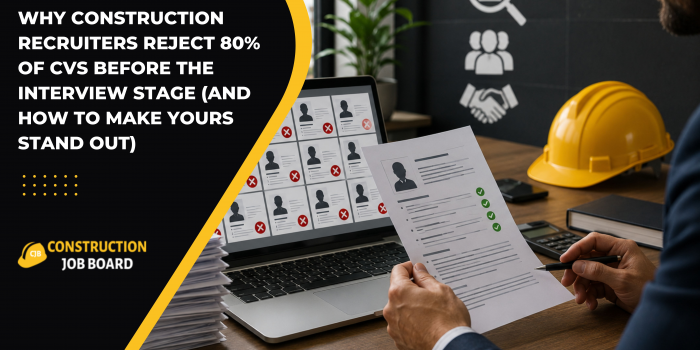
Why Construction Recruiters Reject 80% of CVs Before the Interview Stage (And How to Make Yours Stand Out)
Applying for construction jobs can be frustrating. You spend time updating your CV, submit applications to multiple vacancies, and then… nothing. No interview, no phone call, and often not even a rejection email.
If this sounds familiar, you're not alone.
Construction recruiters review hundreds of applications every week. Whether they're hiring for Site Managers, Quantity Surveyors, Electricians, Civil Engineers, or Labourers, they have one goal: identify the most suitable candidates as quickly as possible.
The reality is that many CVs are rejected within the first few seconds—not because the candidate lacks experience, but because the CV fails to communicate that experience effectively.
Understanding how recruiters review applications can dramatically improve your chances of securing interviews.
How Long Does a Recruiter Spend Looking at Your CV?
Most recruiters don't read every CV word for word during the first review.
Instead, they perform a quick scan to answer a few important questions:
- Does the candidate match the role?
- Do they have relevant construction experience?
- Are the required qualifications listed?
- Is the CV organised and easy to read?
- Should this application move to the next stage?
If recruiters cannot find these answers quickly, they often move to the next application.
That's why your CV needs to communicate value immediately.
Mistake #1: Using the Same CV for Every Job
One of the biggest mistakes candidates make is sending exactly the same CV for every application.
Construction employers hire for very different roles.
For example:
- A Site Manager position focuses on leadership, programme delivery, health and safety, and subcontractor management.
- A Quantity Surveyor role prioritises cost control, contracts, procurement, and commercial reporting.
- A Civil Engineer vacancy may require technical design, infrastructure experience, and compliance knowledge.
Submitting a generic CV tells recruiters that you haven't tailored your application.
How to fix it
Read the job description carefully.
Update your professional summary, key skills, and work experience so they reflect the employer's priorities.
A customised CV almost always performs better than a generic one.
Mistake #2: Missing Essential Certifications
Construction recruitment often depends on certifications.
Recruiters regularly search for qualifications such as:
- CSCS Card
- SMSTS
- SSSTS
- CPCS
- First Aid at Work
- NEBOSH
- IOSH
If these qualifications are buried deep within your CV—or missing completely—you may be overlooked.
How to fix it
Create a dedicated Certifications section near the top of your CV so recruiters can find it immediately.
Mistake #3: Listing Responsibilities Instead of Achievements
Many CVs simply describe daily duties.
For example:
Responsible for managing subcontractors.
This doesn't explain your impact.
A stronger version would be:
Managed a team of 35 subcontractors across a £12 million residential development, helping deliver the project two weeks ahead of schedule.
Achievements give recruiters evidence of your ability.
Whenever possible, include numbers such as:
- Project values
- Team sizes
- Budgets managed
- Deadlines achieved
- Safety improvements
- Cost savings
Mistake #4: Ignoring Keywords
Many employers use Applicant Tracking Systems (ATS) before a recruiter even sees your CV.
These systems search for keywords that match the job description.
For example, if a vacancy repeatedly mentions:
- Project Planning
- NEC Contracts
- AutoCAD
- BIM
- Health and Safety
- Commercial Management
and your CV contains none of these terms—even if you have the experience—you could be filtered out.
How to fix it
Use the same professional terminology found in the job advert, provided it accurately reflects your skills and experience.
Avoid keyword stuffing. Keep the language natural.
Mistake #5: Poor Formatting
Recruiters value clarity.
Common formatting problems include:
- Large blocks of text
- Inconsistent fonts
- Too many colours
- Tiny font sizes
- Complex tables
- Images that ATS software cannot read
A clean layout makes your CV easier to scan.
Use:
- Clear headings
- Bullet points
- Consistent spacing
- Professional fonts
- Two pages where possible
Mistake #6: No Professional Summary
Your professional summary is one of the first sections recruiters read.
This is your opportunity to explain who you are in three or four concise sentences.
A good summary should include:
- Years of experience
- Main area of expertise
- Key certifications
- Career achievements
- Career goals
This immediately tells recruiters why you're suitable for the role.
Mistake #7: Employment Gaps Without Context
Career breaks are common.
The problem isn't the gap itself—it's leaving recruiters to guess why it exists.
If you took time away from work because of training, family commitments, travel, or redundancy, explain this briefly.
Transparency builds trust.
Mistake #8: Forgetting Soft Skills
Construction is a people-focused industry.
Recruiters also look for evidence of:
- Leadership
- Communication
- Problem-solving
- Time management
- Team collaboration
- Client relationship management
Instead of listing these skills, demonstrate them through real examples in your work history.
What Construction Recruiters Want to See
A strong construction CV usually includes:
- A clear professional profile
- Relevant work experience
- Project achievements with measurable results
- Industry certifications
- Technical software knowledge
- Health and safety awareness
- Professional references (available on request)
- Keywords aligned with the role
When recruiters can quickly identify these elements, your chances of progressing increase significantly.
Before You Submit Your CV
Ask yourself these questions:
- Have I customised this CV for the job?
- Are my qualifications easy to find?
- Have I included measurable achievements?
- Is the formatting clean and professional?
- Does my CV reflect the employer's requirements?
If the answer to all five questions is yes, you're already ahead of many applicants.
Final Thoughts
A construction CV should do more than list previous jobs—it should demonstrate why you're the right person for the role.
Recruiters are not looking for the longest CV. They're looking for the clearest one.
By tailoring your application, highlighting measurable achievements, showcasing your certifications, and presenting your experience in a professional format, you can greatly improve your chances of being shortlisted.
Whether you're applying for your first construction role or progressing into senior management, a well-structured CV remains one of the most valuable tools in your career.
People Also Ask
How can I improve my construction CV?
Tailor it to each job, highlight certifications, include measurable achievements, use role-specific keywords, and keep the layout clear and professional.
Do construction recruiters use ATS software?
Yes. Many employers and recruitment agencies use Applicant Tracking Systems to screen CVs before a recruiter reviews them.
Should I include every construction job I've had?
Focus on the most relevant experience. Highlight projects, responsibilities, and achievements that relate to the role you're applying for.
What certifications should I include on a construction CV?
Include any relevant qualifications such as CSCS, SMSTS, SSSTS, CPCS, NEBOSH, IOSH, First Aid, and trade-specific certifications.
FAQs
Why do construction recruiters reject CVs?
Construction recruiters reject CVs when they are generic, poorly formatted, missing key qualifications, or fail to demonstrate relevant achievements and experience.
How long should a construction CV be?
For most professionals, two pages are ideal. Focus on relevant experience, measurable achievements, and qualifications.
Is it important to customise my CV for every application?
Yes. Tailoring your CV to match each job description significantly improves your chances of being shortlisted.
What is the biggest mistake people make on construction CVs?
The most common mistake is describing job duties instead of showing measurable achievements that demonstrate real value to employers.