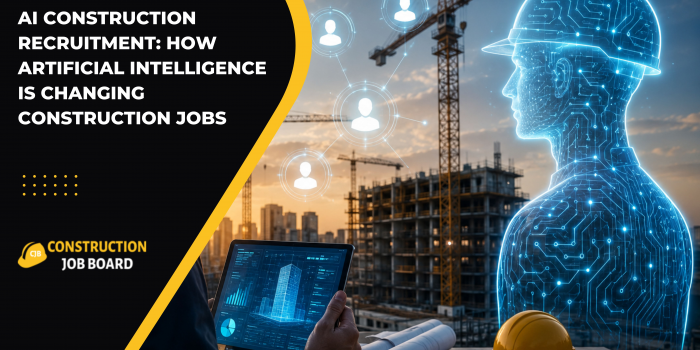
AI Construction Recruitment: How Artificial Intelligence Is Changing Construction Jobs
27/07/2026
How AI Construction Recruitment Is Changing Construction Jobs: What Job Seekers Need to Know
The rise of AI Construction Recruitment is transforming how employers find skilled professionals and how job seekers secure opportunities across the UK construction industry. From CV screening and candidate matching to interview scheduling and workforce planning, artificial intelligence is becoming a key part of recruitment. While AI is changing hiring processes, it is not replacing skilled construction workers. Instead, it is helping employers recruit faster and helping candidates connect with roles that better match their skills and experience.
Whether you're looking for opportunities as a labourer, quantity surveyor, site manager, civil engineer, electrician, or project manager, understanding how AI is influencing recruitment can give you a competitive advantage.
Why AI Is Becoming Essential in Construction Recruitment
The UK construction industry continues to face labour shortages while managing large infrastructure, housing, renewable energy, and commercial development projects. Recruiters often receive hundreds of applications for a single vacancy, making manual screening time-consuming.
AI recruitment platforms help employers:
- Screen thousands of CVs within minutes
- Match candidates to suitable vacancies
- Reduce recruitment costs
- Improve hiring speed
- Identify transferable skills
- Reduce administrative work for recruiters
This allows recruitment teams to spend more time interviewing qualified candidates instead of sorting through applications manually.
What Is AI Construction Recruitment?
AI construction recruitment refers to the use of artificial intelligence technologies throughout the hiring process. These tools analyze candidate information, compare it with job requirements, and recommend suitable applicants.
Common AI-powered recruitment tasks include:
|
Recruitment Task |
How AI Helps |
|
CV Screening |
Identifies relevant skills and experience |
|
Candidate Matching |
Matches applicants with suitable vacancies |
|
Job Recommendations |
Suggests relevant construction jobs |
|
Skills Analysis |
Detects missing qualifications or certifications |
|
Interview Scheduling |
Automates meeting arrangements |
|
Recruitment Analytics |
Tracks hiring trends and recruitment performance |
Rather than replacing recruiters, AI supports them by improving efficiency and reducing repetitive tasks.
How Construction Companies Are Using AI Today
Many UK construction employers have already introduced AI into their recruitment processes. Some of the most common applications include:
Automated CV Screening
Instead of manually reviewing every application, AI software scans CVs for relevant qualifications, certifications, experience, and keywords.
For example, if a vacancy requires:
- CSCS Card
- SMSTS
- Site Management
- Health & Safety
- Residential Construction
The system identifies candidates whose CVs demonstrate these requirements.
Intelligent Candidate Matching
Modern recruitment software compares candidate profiles with job descriptions to recommend the best matches.
Instead of searching manually, recruiters receive a shortlist of applicants who closely meet the role's requirements.
This benefits both employers and candidates by reducing the time needed to find suitable opportunities.
Predicting Hiring Needs
Construction companies increasingly use AI to forecast future workforce requirements based on:
- Upcoming projects
- Seasonal demand
- Historical recruitment data
- Regional labour shortages
This allows employers to recruit before skills shortages become critical.
Will AI Replace Construction Recruiters?
No.
Recruitment remains a people-focused profession.
Construction hiring involves evaluating:
- Communication skills
- Leadership ability
- Teamwork
- Reliability
- Problem-solving
- Cultural fit
These qualities are difficult for AI to assess accurately without human involvement.
Instead, AI handles repetitive administrative tasks while recruiters focus on interviewing, relationship building, and final hiring decisions.
How AI Is Affecting Construction Job Seekers
For candidates, AI changes how applications are reviewed.
Many employers now use Applicant Tracking Systems (ATS) enhanced with AI capabilities before a recruiter sees a CV.
This means applicants should ensure their CV is easy for both AI systems and recruiters to understand.
How to Make Your CV AI-Friendly
Use Clear Job Titles
Instead of creative titles, use standard industry terminology.
Examples include:
- Site Manager
- Quantity Surveyor
- Civil Engineer
- Electrician
- Carpenter
- Project Manager
Standard titles improve matching accuracy.
Include Relevant Skills
AI looks for specific technical skills, certifications, and software knowledge.
Examples include:
- AutoCAD
- BIM
- Revit
- Primavera P6
- Microsoft Project
- NEC Contracts
- Health & Safety
- Risk Assessment
- Site Supervision
Include only skills you genuinely possess.
Mention Certifications
Construction employers frequently search for certifications such as:
- CSCS Card
- SMSTS
- SSSTS
- First Aid at Work
- NEBOSH
- IOSH
- CPCS
- NPORS
Listing these clearly can improve visibility in recruitment systems.
Quantify Achievements
AI systems and recruiters both value measurable accomplishments.
Instead of writing:
Managed construction projects.
Write:
Managed residential developments valued at £12 million while supervising 40 subcontractors.
Specific details demonstrate impact.
The Growing Importance of Digital Skills
Construction employers increasingly seek candidates with digital capabilities alongside traditional trade skills.
Examples include:
- BIM software
- Digital surveying
- Drone inspections
- Digital reporting
- Cloud collaboration
- Mobile site management tools
- AI-assisted estimating
Learning these skills can significantly improve employability.
Construction Roles Most Influenced by AI Recruitment
AI is increasingly used to recruit for roles such as:
- Quantity Surveyor
- Site Manager
- Project Manager
- Civil Engineer
- Planning Engineer
- Building Services Engineer
- Estimator
- BIM Coordinator
- Design Manager
- Health and Safety Manager
Skilled trades continue to be in high demand, but AI is helping employers identify qualified candidates more efficiently.
Benefits of AI Construction Recruitment
Faster Hiring
Vacancies are filled more quickly, reducing project delays.
Better Job Matching
Candidates receive opportunities aligned with their qualifications and experience.
Reduced Bias
When configured appropriately, AI can help standardize initial screening by focusing on job-related criteria.
Improved Candidate Experience
Automated updates and faster responses provide applicants with a more efficient recruitment journey.
Challenges to Be Aware Of
AI recruitment also has limitations.
Potential challenges include:
- Overreliance on keyword matching
- Poorly formatted CVs being overlooked
- Inaccurate skill interpretation
- Bias if AI systems are trained on unbalanced historical data
For this reason, candidates should create clear, well-structured CVs while ensuring their experience is accurately described.
Preparing for the Future of Construction Recruitment
AI adoption will continue to grow across construction recruitment, but employers will still rely on skilled professionals who can solve problems, collaborate effectively, and deliver projects safely.
To stay competitive:
- Keep certifications up to date.
- Learn digital construction tools such as BIM and project management software.
- Tailor your CV to each application.
- Highlight measurable achievements.
- Continue developing both technical and soft skills.
Candidates who combine practical construction expertise with digital knowledge will be well positioned for future opportunities.
Conclusion
AI Construction Recruitment is reshaping the hiring landscape across the UK construction industry by making recruitment faster, more efficient, and more data-driven. Rather than replacing workers or recruiters, AI is helping employers identify qualified candidates more effectively while enabling job seekers to discover roles that match their skills.
As AI becomes a standard part of recruitment, candidates who maintain up-to-date certifications, develop digital construction skills, and present clear, achievement-focused CVs will have the best chance of success. Embracing these changes today can help construction professionals build stronger careers in an increasingly technology-driven industry.
Frequently Asked Questions
1. What is AI construction recruitment?
AI construction recruitment uses artificial intelligence to help employers screen CVs, match candidates with vacancies, automate administrative tasks, and improve hiring efficiency.
2. Will AI replace construction recruiters?
No. AI supports recruiters by automating repetitive tasks, but human recruiters remain essential for interviews, relationship building, and final hiring decisions.
3. How can I make my CV suitable for AI recruitment systems?
Use clear job titles, include relevant certifications, mention technical skills naturally, and quantify your achievements with measurable results.
4. Which construction jobs are most affected by AI recruitment?
Professional roles such as Quantity Surveyors, Site Managers, Civil Engineers, Estimators, BIM Coordinators, and Project Managers are increasingly recruited using AI-supported systems.
5. Do construction companies use AI in hiring today?
Yes. Many UK construction companies use AI-powered Applicant Tracking Systems to screen applications, recommend candidates, and improve recruitment efficiency.
6. What digital skills improve construction career prospects?
Skills such as BIM, AutoCAD, Revit, project management software, digital surveying, and data analysis are increasingly valued by employers.