05/10/2026
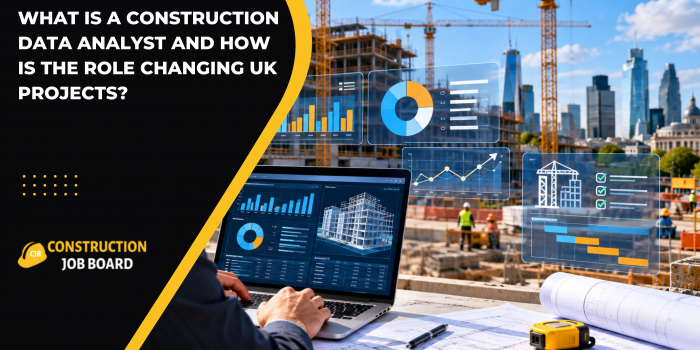
What Is a Construction Data Analyst and How Is the Role Changing UK Projects?
A Construction Data Analyst uses project data to help construction companies understand costs, schedules, productivity, resources, quality and project performance. As UK construction becomes increasingly digital, the role is developing at the intersection of construction knowledge, data analysis and digital project management.
Construction projects generate large amounts of information. Cost reports, programmes, labour records, procurement information, site progress, quality inspections, safety records and BIM data can all provide useful insights when collected and analysed effectively.
For people interested in both construction and analytical work, construction data analysis is becoming an increasingly relevant career area.
What does a Construction Data Analyst do?
A Construction Data Analyst collects, organises, analyses and communicates information generated during construction projects.
The exact responsibilities vary between employers and projects, but typical activities can include:
- Analysing project costs and expenditure
- Monitoring programme and schedule performance
- Examining labour and resource productivity
- Creating reports and dashboards
- Identifying trends in project data
- Supporting forecasting and planning
- Analysing procurement and material information
- Monitoring quality and performance indicators
- Supporting commercial and project management teams
- Presenting findings to construction professionals
The role is not simply about producing spreadsheets. The purpose of analysis is to turn project information into insights that teams can use when planning and managing work.
The UK Government's data analyst capability framework describes data analysts as professionals who collect, manage, explore and communicate data to support organisational objectives. Construction applies these principles to the specific requirements of the built environment.
Why is data becoming important in construction?
Construction companies have always generated data, but digital systems are increasing the amount and variety of information available.
Modern projects can involve:
- Building Information Modelling (BIM)
- Common Data Environments (CDEs)
- Digital project-management platforms
- Cost-management systems
- Scheduling software
- Site-monitoring technologies
- Digital quality systems
- Drones and surveying technologies
- Equipment and productivity data
- Environmental and sustainability information
This creates an opportunity to analyse information across different stages of a project.
RICS has highlighted the importance of data management and data analytics within the future development of BIM and digital construction.
The result is a growing need for professionals who understand not only data but also how construction projects operate.
What types of construction data can analysts work with?
A Construction Data Analyst may work with several different categories of information.
Cost data
Cost information can include:
- Project budgets
- Actual expenditure
- Forecast costs
- Variations
- Procurement costs
- Labour costs
- Material costs
Analysing this information can help commercial teams understand how financial performance is developing.
Programme data
Construction programmes contain information about activities, milestones and deadlines.
Analysts may examine:
- Planned versus actual progress
- Programme delays
- Activity completion
- Resource requirements
- Project milestones
- Forecast completion dates
Labour and productivity data
Labour information can help organisations understand how resources are being used.
Analysis may cover:
- Labour hours
- Productivity rates
- Workforce requirements
- Resource allocation
- Project performance
Quality and safety data
Construction projects also generate information through inspections, audits and incident reporting.
Analysts can help identify recurring patterns and areas requiring further investigation.
BIM and digital project data
BIM systems contain information about buildings, components and project processes.
The UK Government's recent work on AI skills in construction also identifies understanding data from BIM systems as an emerging digital capability.
What skills does a Construction Data Analyst need?
A successful Construction Data Analyst normally needs a combination of analytical, technical and construction-related skills.
Data analysis
The ability to clean, organise, interpret and analyse information is fundamental.
Analysts should be comfortable identifying patterns, comparing datasets and explaining what the results mean.
Excel
Excel remains useful for many construction data tasks, particularly for calculations, reporting, data cleaning and analysis.
Advanced Excel skills can include:
- Pivot tables
- Lookup functions
- Data validation
- Conditional logic
- Charts
- Power Query
Power BI and data visualisation
Data visualisation allows complex information to be presented in a format that project teams can understand.
Power BI and similar tools can be used to develop dashboards covering areas such as cost, progress and performance.
A current UK construction graduate data analyst role at Bouygues Construction, for example, includes data analysis, Power BI dashboards and Power Platform applications among its responsibilities and desired capabilities.
SQL and programming
Some construction analytics positions may require SQL or programming knowledge.
Python can be useful for:
- Data processing
- Automation
- Statistical analysis
- Larger datasets
- Repetitive reporting tasks
Not every Construction Data Analyst role requires programming, but technical skills can expand the types of analysis a professional can undertake.
Construction knowledge
Data skills alone do not necessarily provide an understanding of construction.
Knowledge of areas such as:
- Construction processes
- Project management
- Quantity surveying
- Procurement
- Scheduling
- Site operations
- BIM
- Health and safety
can help analysts interpret data in its proper project context.
Do you need construction experience to become a Construction Data Analyst?
Not necessarily.
There are several potential routes into construction data analysis.
A graduate with a data, engineering, construction, mathematics, statistics or related background may enter through a graduate or junior analyst role.
Another route is to move from an existing construction position into a more data-focused role.
For example, professionals working in:
- Quantity surveying
- Project controls
- Planning
- Commercial management
- Site management
- BIM
- Estimating
may already have valuable project knowledge and can develop additional data-analysis skills.
A current Construction Data & Research Analyst position in London demonstrates this combination: the role combines construction knowledge with data analytics, cost and schedule information, Power BI, Python, common data environments and AI-related data analysis.
Which qualifications can help?
There is no single qualification that defines every Construction Data Analyst career.
Depending on the position, useful educational backgrounds may include:
- Construction management
- Quantity surveying
- Civil engineering
- Data analytics
- Statistics
- Mathematics
- Business analytics
- Computer science
- Engineering
Professional development can also focus on specific tools and construction technologies.
Useful areas to develop include:
- Advanced Excel
- Power BI
- SQL
- Python
- BIM fundamentals
- Data visualisation
- Project controls
- Construction cost management
- Common Data Environments
The most appropriate combination depends on the employer and the type of construction projects involved.
How is the role changing with AI?
AI is introducing another layer to construction data analysis.
AI can support activities such as identifying patterns, processing information, forecasting and assisting with decision-making.
However, construction professionals still need to understand the quality and context of the information being analysed.
The UK Government's sectoral overview of AI skills in construction identifies technical skills such as understanding BIM data alongside non-technical capabilities such as interpreting AI outputs and applying them to on-site decisions.
This means future construction data roles may involve more than traditional reporting.
Professionals could increasingly work with:
- Predictive analytics
- Automated reporting
- AI-assisted forecasting
- Digital twins
- BIM information
- Project performance dashboards
- Automated data processing
The human ability to understand construction context and communicate analytical findings will remain important.
Is Construction Data Analyst a construction job or a data job?
It can be both.
The balance depends on the employer.
A data-focused organisation may expect stronger technical analytics skills, while a contractor or developer may place greater emphasis on construction knowledge.
The role therefore sits between several professional areas:
Construction + Data + Digital Technology + Project Management
This combination makes it different from a traditional general-purpose data analyst role.
A construction data analyst needs to understand not only what the numbers show but also why those numbers matter to a project.
What career progression can a Construction Data Analyst have?
Career progression varies between employers, but possible pathways can include:
Junior Data Analyst → Construction Data Analyst → Senior Construction Data Analyst → Data/Analytics Manager
Alternatively, professionals may move towards:
- Project Controls
- Commercial Analytics
- Digital Construction
- BIM and information management
- Construction technology
- Business intelligence
- Project management
- Data management
The best route depends on whether the individual wants to specialise in analytics or move into wider construction and digital management.
What should you learn if you want to enter this field?
A practical learning path could start with construction fundamentals and basic data analysis.
Step 1: Understand construction
Learn how projects move through:
Design → Procurement → Planning → Construction → Handover
Step 2: Build Excel skills
Become comfortable with formulas, pivot tables, data cleaning and reporting.
Step 3: Learn Power BI
Practise creating dashboards from construction-style datasets.
Step 4: Develop SQL knowledge
SQL can help when working with structured databases and larger datasets.
Step 5: Understand BIM
You do not necessarily need to become a BIM specialist, but understanding BIM data can be valuable.
Step 6: Build a portfolio
Create example dashboards using construction-related data such as:
- Project costs
- Programme progress
- Labour productivity
- Material usage
- Quality inspections
A portfolio can demonstrate that you understand both analytical methods and construction applications.
Key Takeaways
- A Construction Data Analyst combines construction knowledge with data-analysis skills.
- The role can involve cost, schedule, labour, procurement, quality and productivity data.
- Excel, Power BI and data visualisation are useful skills.
- SQL and Python can provide additional technical capabilities.
- BIM and Common Data Environments are relevant to modern construction data workflows.
- Construction experience can provide valuable context for analytical roles.
- AI is creating additional opportunities for data-driven construction workflows.
- Career paths can lead towards analytics, project controls, digital construction, BIM, commercial analysis or management.
Frequently Asked Questions
What is a Construction Data Analyst?
A Construction Data Analyst analyses information generated by construction projects to identify trends, produce reports and support project and business decision-making.
What does a Construction Data Analyst do?
Typical responsibilities include analysing project costs, schedules, productivity, procurement, quality and other performance information and presenting the findings to relevant teams.
What skills does a Construction Data Analyst need?
Important skills can include Excel, data analysis, Power BI, data visualisation, communication and construction knowledge. SQL, Python and BIM knowledge may also be useful depending on the role.
Do you need a degree to become a Construction Data Analyst?
There is no single degree requirement for every position. Employers may look for backgrounds in construction, engineering, data analytics, statistics, mathematics, business or related subjects.
Can a Quantity Surveyor become a Construction Data Analyst?
Yes. Quantity surveyors already work with construction costs, commercial information and project data, so developing additional analytics and visualisation skills can provide a potential route towards data-focused construction roles.