24/09/2026
What Should You Put on a Construction CV to Get Noticed?
A strong construction CV should quickly show employers what type of construction work you have experience in, what responsibilities you have handled, which qualifications you hold and what practical skills you can bring to a project. For construction professionals, the most useful CV content is usually specific evidence of experience rather than a long list of general qualities.
Direct Answer
A construction CV should include your target role, relevant construction experience, project experience, technical skills, qualifications, certifications, health and safety training, software knowledge and measurable achievements where appropriate. The information should be organised so that an employer can understand your construction background quickly.
A good construction CV does not need to include every task you have ever performed. It should prioritise the experience and skills that are most relevant to the job you are applying for.
Key Takeaways
- Put your relevant construction experience near the top of your CV.
- Clearly state your target construction role.
- Include project types, responsibilities and relevant achievements.
- List qualifications and industry certifications accurately.
- Mention site, technical, commercial or management experience where relevant.
- Include construction software and digital skills you actually use.
- Use specific examples instead of generic phrases.
- Adapt your CV to the type of construction job you want.
- Keep information easy for recruiters to scan.
- Never exaggerate qualifications, experience or responsibilities.
What Information Should a Construction CV Include?
A construction CV will normally contain several important sections.
These can include:
- Professional profile
- Key construction skills
- Employment history
- Project experience
- Qualifications
- Certifications and training
- Software and technical skills
- Additional relevant information
The exact structure can vary depending on whether you are applying for a skilled trade, engineering position, surveying role, site-management position or senior construction job.
The most important principle is relevance.
If a role is primarily site-based, your site experience should be easy to find. If you are applying for a Quantity Surveyor position, commercial and cost-related experience should receive greater emphasis.
What Should You Put in the Personal Profile?
The opening profile should provide a short summary of your professional background.
Rather than using vague statements such as:
“Hard-working individual with excellent communication skills.”
explain what you actually do.
For example, a construction professional might describe:
- Years of industry experience
- Main area of construction
- Type of projects worked on
- Current or most recent role
- Relevant technical expertise
- Management or specialist experience
A concise profile allows a recruiter to understand your professional background before reading the rest of the CV.
How Should You Describe Construction Experience?
Your employment history should explain what you were responsible for and the type of projects you worked on.
Instead of listing only job titles, include useful details such as:
- Project type
- Project value, where appropriate
- Project size or scale
- Construction sector
- Responsibilities
- Teams managed
- Contractors or subcontractors coordinated
- Technical activities
- Commercial responsibilities
- Health and safety responsibilities
- Relevant project outcomes
For example, a Site Manager could explain responsibility for coordinating subcontractors, monitoring programme progress, managing site activities and supporting health and safety requirements.
A Quantity Surveyor could highlight cost control, valuations, procurement, subcontractor accounts and commercial reporting where these were part of the role.
Specific information is more useful than generic descriptions.
Should You Include Construction Projects on Your CV?
Yes, particularly when project experience demonstrates skills that are relevant to the vacancy.
A separate project section can be particularly useful for professionals who have worked across different sectors or large projects.
You could include:
Project: Commercial development
Role: Site Manager
Responsibilities: Site coordination, subcontractor management, programme monitoring and quality control.
The format can be adapted according to your profession.
For engineers, surveyors, architects, project managers and other professionals, project examples can demonstrate technical and commercial experience that may not be obvious from the job title alone.
Should You Include Project Values on a Construction CV?
Project value can be useful when it provides meaningful context, particularly for management, commercial and senior positions.
For example, a Project Manager who has worked on projects of significantly different scales may want to demonstrate the scale of responsibility involved.
However, project value should only be included where it is accurate and appropriate to disclose.
Other measures can sometimes provide better context, including:
- Project size
- Number of workers
- Number of subcontractors
- Programme duration
- Number of buildings
- Site area
- Contract type
- Scope of work
The best information depends on the role.
Which Construction Skills Should You Include?
Your skills section should reflect the vacancy rather than contain every skill you have ever encountered.
Construction CV skills may include:
- Site management
- Project management
- Quantity surveying
- Cost control
- Estimating
- Procurement
- Contract administration
- Construction planning
- Health and safety
- Quality management
- Risk management
- Building regulations awareness
- Technical drawing
- Surveying
- Setting out
- Construction methods
- Subcontractor management
- Client communication
- Team leadership
- BIM
- Construction software
Choose skills that genuinely match your experience.
For example, someone applying for Construction Manager Jobs should highlight management, coordination, planning and project-delivery experience rather than filling the CV with unrelated technical keywords.
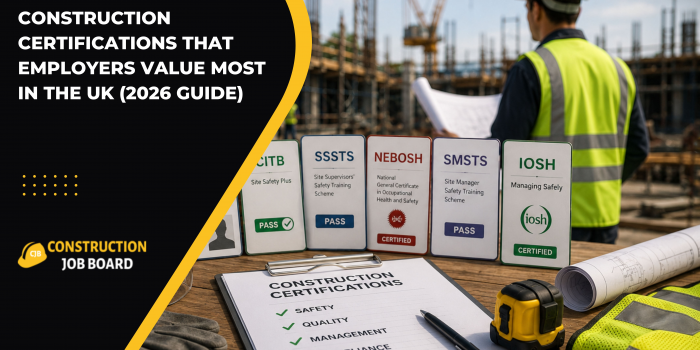
Should You Include CSCS and Other Certifications?
Relevant certifications should be clearly visible.
Depending on your profession, this could include:
- CSCS
- CPCS
- NPORS
- ECS
- SMSTS
- SSSTS
- NVQs
- HNCs
- HNDs
- Professional qualifications
- Trade certifications
- Health and safety training
Do not simply write “CSCS qualified”.
Where relevant, identify the card or certification and ensure that information is current and accurate.
For some roles, certifications can help recruiters establish whether a candidate meets a basic job requirement.
How Should You Show Construction Software Skills?
Digital skills are increasingly relevant across construction roles.
Depending on your profession, this could include experience with:
- Revit
- AutoCAD
- Navisworks
- Civil 3D
- Microsoft Project
- Primavera P6
- Cost management software
- Estimating software
- Document management platforms
- Common Data Environment platforms
However, software should not become a keyword list.
Explain how you used important tools where possible.
For example:
“Used Revit and Navisworks to review coordinated project information and support multidisciplinary design coordination.”
This provides more useful information than simply listing software names.
Should You Include Achievements on a Construction CV?
Where appropriate, achievements can make your experience more specific.
An achievement could relate to:
- Improving project efficiency
- Reducing delays
- Supporting cost control
- Improving site processes
- Completing work within programme
- Managing a larger team
- Supporting successful project delivery
- Improving safety processes
- Resolving a significant project issue
Avoid inventing percentages or financial figures simply to make a CV appear impressive.
If you cannot quantify an achievement accurately, explain the contribution you made instead.
How Long Should a Construction CV Be?
There is no universal length that works for every construction professional.
A junior worker with limited experience may need only a relatively short CV.
A senior construction professional with many years of project experience may need more space to demonstrate their career history.
The objective should be relevance rather than length.
Remove information that does not help demonstrate your suitability for the target role.
Older experience can also be summarised where it is no longer directly relevant.
Should You Tailor a Construction CV for Every Job?
Tailoring can make it easier for an employer to identify relevant experience.
For example, a Project Manager vacancy might emphasise:
- Programme management
- Stakeholder management
- Contract administration
- Risk management
- Commercial awareness
A CV for that vacancy should make relevant experience easy to find.
A CV for a Site Manager position may need greater emphasis on:
- Site operations
- Subcontractor coordination
- Health and safety
- Quality
- Programme delivery
- Site documentation
The underlying career history does not need to change. The emphasis can change according to the vacancy.
What Construction CV Keywords Should You Use?
Keywords should naturally reflect the language used in genuine job descriptions.
Examples include:
- Construction project management
- Site management
- Quantity surveying
- Construction estimating
- Contract management
- Construction planning
- Health and safety
- Subcontractor management
- Procurement
- Cost control
- Quality assurance
- BIM
- Construction compliance
- Project coordination
Do not add keywords for skills you do not possess.
A CV should remain accurate even when it is being optimised for recruitment systems.
What Should You Leave Out of a Construction CV?
A construction CV can become less effective when it contains unnecessary information.
Consider removing:
- Irrelevant hobbies
- Excessive personal information
- Long paragraphs
- Repeated responsibilities
- Outdated qualifications that are no longer relevant
- Unverified claims
- Skills you cannot demonstrate
- Every job responsibility from decades of employment
The objective is to make relevant evidence easy to identify.
How Can Different Construction Professionals Structure Their CV?
Different construction careers require different emphasis.
Quantity Surveyor CV
Focus on:
- Cost management
- Valuations
- Procurement
- Subcontractor accounts
- Commercial reporting
- Contract administration
- Project values
Site Manager CV
Focus on:
- Site operations
- Subcontractor management
- Health and safety
- Quality
- Programme
- Site coordination
Civil Engineer CV
Focus on:
- Engineering projects
- Technical responsibilities
- Design
- Site engineering
- Setting out
- Technical software
- Engineering qualifications
Construction Manager CV
Focus on:
- Project delivery
- Team leadership
- Programme
- Cost
- Quality
- Risk
- Stakeholder coordination
This role-specific approach makes the CV more relevant without requiring a completely different document for every application.
How Can You Make Your Construction CV Easier to Read?
Recruiters often need to review large numbers of applications.
Make important information easy to locate.
Use:
- Clear headings
- Short paragraphs
- Bullet points
- Consistent formatting
- Relevant keywords
- Reverse chronological employment history
- Clear qualification details
Avoid filling every section with dense blocks of text.
A CV should communicate information quickly.
Final Thoughts
A construction CV should provide evidence of what you can do, where you have worked and what type of projects you have contributed to.
The strongest CV content is usually specific: project types, responsibilities, qualifications, technical skills, certifications and genuine achievements.
Whether you are applying for a trade position, engineering role, surveying position or construction-management vacancy, the same principle applies: make the most relevant evidence easy to find.
A focused CV can give employers a clearer understanding of your construction background and help you present your experience more effectively when searching for your next opportunity.
FAQs
1. What should I include on a construction CV?
Include your professional profile, relevant construction experience, project experience, skills, qualifications, certifications, software knowledge and relevant achievements.
2. Should I include every construction job I have had?
Not necessarily. Prioritise experience that is relevant to the role you are applying for. Older or unrelated experience can usually be shortened.
3. Should construction qualifications be listed on a CV?
Yes. Relevant qualifications, certifications and training should be clearly listed, particularly where they relate directly to the requirements of the construction role.
4. Should I include project values on my construction CV?
Project values can provide useful context for some roles, particularly senior management and commercial positions. Only include figures that are accurate and appropriate to disclose.
5. How can I make my construction CV stand out?
Focus on specific evidence rather than generic claims. Highlight relevant projects, responsibilities, qualifications, technical skills and genuine achievements that match the type of construction job you want.