24/08/2026
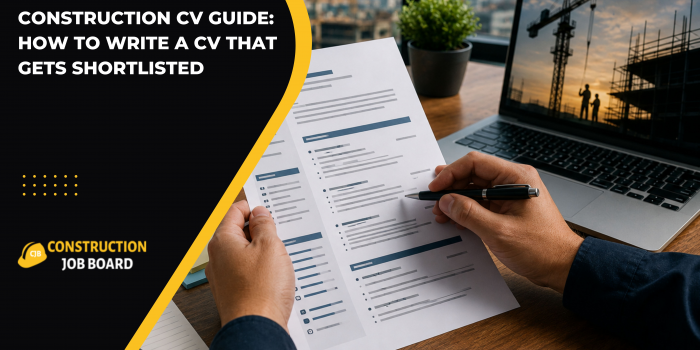
How to Write a Construction CV That Gets Shortlisted
Introduction
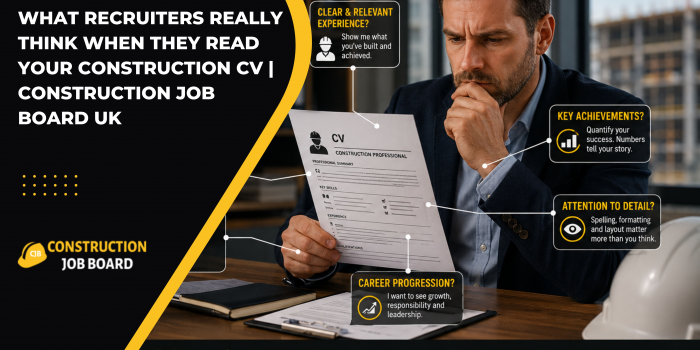
A strong construction CV can make a significant difference when applying for jobs across the UK construction industry. Whether you are applying for a labourer, carpenter, electrician, site supervisor, quantity surveyor, site manager or construction manager role, your CV needs to quickly demonstrate your relevant experience, practical skills, qualifications and suitability for the position. Construction employers often receive many applications, so a clear and targeted CV can help your application stand out from other candidates.
Your CV should not simply list every job you have ever had. Instead, it should present the experience and skills that are most relevant to the construction role you want. This guide explains how to create a professional CV for construction jobs and what employers are likely to look for when reviewing applications.
What Should a Construction CV Include?
A professional construction CV should normally contain the following sections:
- Personal profile
- Key construction skills
- Employment history
- Construction qualifications
- Certifications and cards
- Education and training
- Relevant projects
- Additional information
- References
The exact structure can vary depending on your experience and the type of construction job you are applying for.
For example, an experienced site manager should emphasise project management, team leadership, health and safety and commercial responsibilities. A construction labourer may need to focus more on site experience, practical skills, reliability and relevant training.
How to Structure Your Construction CV
A simple and professional structure makes it easier for recruiters and employers to identify your suitability.
1. Add Your Contact Details
Start your CV with your basic contact information.
Include:
- Full name
- Phone number
- Professional email address
- Location
- LinkedIn profile, if relevant
You generally do not need to include personal information such as your date of birth, marital status or photograph unless specifically requested.
Keep the contact section simple and easy to find.
2. Write a Strong Personal Profile
Your personal profile should provide a short introduction explaining who you are, your construction experience and the type of role you are seeking.
Try to keep it to approximately three to five sentences.
For example:
Experienced construction professional with several years of experience working on residential and commercial projects. Skilled in coordinating site activities, maintaining health and safety standards and working effectively with contractors and site teams. Holds relevant construction qualifications and is seeking a new opportunity within a professional construction environment.
The profile should be adapted to every job application where possible.
Avoid generic statements such as:
"I am hardworking, reliable and motivated."
These qualities are useful, but employers want evidence of how they relate to construction work.
3. Highlight Your Key Construction Skills
Create a dedicated skills section underneath your profile.
The skills you include should match the job description.
Examples of construction skills include:
- Site management
- Construction project coordination
- Health and safety
- Risk assessment
- Site supervision
- Quantity surveying
- Construction estimating
- Building regulations
- Reading technical drawings
- Site inspections
- Contractor management
- Team leadership
- Quality control
- Construction planning
- Project scheduling
- Budget management
- Building maintenance
- Manual handling
- Setting out
- Plant operation
For skilled trades, include practical skills specific to your trade.
For example, a carpenter could include:
- First and second fix carpentry
- Joinery
- Reading construction drawings
- Timber framing
- Door and window installation
- Measuring and cutting materials
Avoid filling the skills section with skills that are unrelated to the position.
4. Present Your Construction Experience Clearly
Your employment history is one of the most important parts of a CV for construction jobs.
List your most recent or current position first.
For each role, include:
Job Title
Company Name | Location | Dates
Then provide several bullet points describing your responsibilities and achievements.
For example:
- Supervised daily activities across multiple construction work areas.
- Coordinated subcontractors and site workers to maintain project schedules.
- Completed site inspections and supported health and safety procedures.
- Monitored materials and equipment requirements.
- Communicated project updates to site management.
- Helped maintain quality standards throughout the project.
Where possible, include measurable achievements.
Instead of:
Managed construction projects.
Use:
Coordinated subcontractors across three active work areas while supporting delivery against project programme requirements.
Specific evidence makes your experience more credible.
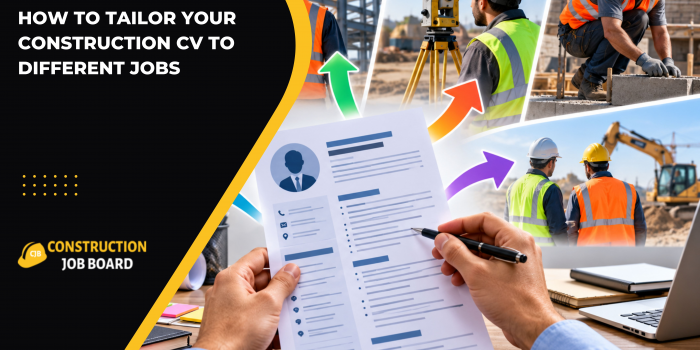
5. Tailor Your CV to the Construction Job
One of the biggest mistakes candidates make is using exactly the same CV for every application.
A CV for a quantity surveyor position should look different from a CV for a labourer position.
Before applying, study the job description and identify:
- Required qualifications
- Technical skills
- Experience requirements
- Software knowledge
- Safety certifications
- Management responsibilities
- Industry-specific terminology
Then reflect the most relevant information in your CV.
For example, if a vacancy asks for experience with construction estimating software, make sure relevant software experience is clearly visible rather than hidden in a long paragraph.
6. Include Relevant Construction Qualifications
Qualifications can be particularly important for construction roles.
Depending on the position, you may include:
- NVQs
- HNCs
- HNDs
- Construction-related degrees
- Apprenticeships
- Trade qualifications
- Health and safety qualifications
- Management training
- Professional memberships
List the qualification, institution and completion date where appropriate.
For example:
HNC Construction and the Built Environment
[College/University]
Completed: [Year]
Do not claim qualifications or certifications that you have not obtained.
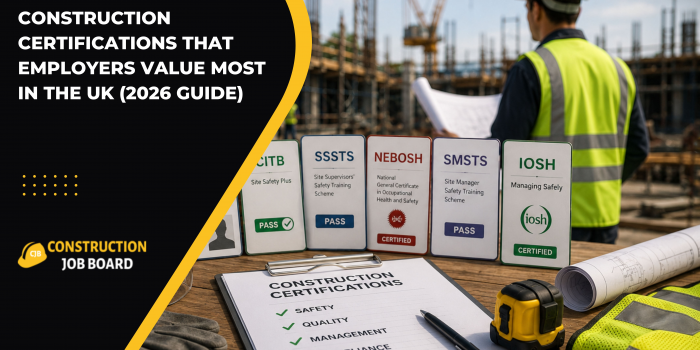
7. Include Relevant Cards and Certifications
Depending on the construction role, relevant cards and certifications can be important.
Where applicable, clearly state relevant credentials such as:
- CSCS
- CPCS
- NPORS
- SMSTS
- SSSTS
- ECS
- IPAF
- PASMA
- First Aid
- Asbestos awareness
- Health and safety qualifications
Only include certifications that you actually hold.
If a particular certification is required for the vacancy, make it easy for the employer to find.
8. Use Construction CV Examples for Inspiration, Not Copying
Looking at construction CV examples can help you understand how to structure your application, but avoid copying another person's CV word for word.
Your CV should accurately represent:
- Your experience
- Your qualifications
- Your skills
- Your responsibilities
- Your achievements
- Your career goals
A copied CV may contain skills or responsibilities that do not reflect your actual experience and could create problems during an interview.
Use examples to understand formatting and presentation rather than copying the content.
9. Keep Your Construction CV Easy to Read
Construction recruiters and hiring managers need to identify important information quickly.
Use:
- Clear headings
- Short paragraphs
- Bullet points
- Consistent formatting
- Professional fonts
- Appropriate spacing
Avoid:
- Large blocks of text
- Excessive colours
- Decorative graphics
- Complicated tables
- Unnecessary personal information
- Spelling mistakes
For most candidates, two pages can be sufficient. However, experienced professionals with extensive relevant project history may require more space.
The priority should always be relevance rather than an arbitrary page count.
10. Include Project Experience Where Relevant
Project experience can make a construction CV stronger, particularly for experienced professionals.
You could include:
Project: Commercial Office Development
Role: Site Manager
Project Value: £X million
Responsibilities:
- Coordinated subcontractors
- Managed site activities
- Supported programme delivery
- Conducted inspections
- Monitored health and safety
- Liaised with project stakeholders
Project information can help employers understand the scale and type of work you have previously handled.
11. Show Achievements, Not Just Responsibilities
A CV becomes more effective when it demonstrates what you achieved.
Compare:
Responsibility:
Managed subcontractors.
Stronger version:
Coordinated multiple subcontractor teams to support project programme requirements and maintain site quality standards.
Where accurate, use measurable information such as:
- Number of workers managed
- Project value
- Number of projects
- Project duration
- Cost savings
- Productivity improvements
- Safety improvements
- Completion milestones
Do not invent figures simply to make your CV appear stronger.
12. Address Employment Gaps Honestly
If you have gaps in your employment history, do not try to hide them.
You can briefly explain relevant periods such as:
- Training
- Education
- Career transition
- Personal circumstances
- Job searching
- Self-employment
The explanation does not need to be lengthy.
The most important thing is to provide an accurate employment history.
13. Proofread Your Construction CV
Spelling and grammar errors can make an otherwise strong CV look unprofessional.
Before submitting your application, check:
- Job titles
- Company names
- Dates
- Qualifications
- Contact details
- Spelling
- Grammar
- Formatting
- File name
Ask someone else to review your CV if possible.
Save the final document using a professional filename, such as:
John-Smith-Construction-CV.pdf
rather than:
CV-final-final-new.pdf
14. Optimise Your CV for Online Applications
Many construction vacancies are advertised and managed online.
This means your CV should be easy for both people and recruitment systems to understand.
Use standard job titles and relevant terminology where it accurately describes your experience.
For example, if you have worked as a "Site Supervisor", use that recognised title rather than replacing it with a vague term such as "Construction Team Leader" unless the latter accurately reflects your role.
Include relevant keywords naturally throughout your CV.
However, avoid keyword stuffing. A CV should remain readable and truthful.
Common Construction CV Mistakes to Avoid
Some common mistakes can reduce the effectiveness of a CV for construction jobs.
Using One CV for Every Vacancy
Different construction roles require different skills. Tailor your CV to each relevant vacancy.
Listing Responsibilities Without Evidence
Explain what you actually did and, where possible, what you achieved.
Including Irrelevant Experience
Prioritise experience that demonstrates your suitability for the construction role.
Making the CV Too Complicated
A clean and professional layout is usually more effective than excessive design.
Leaving Qualifications Unclear
Clearly state relevant qualifications, training and certifications.
Using Unprofessional Email Addresses
Use a simple professional email address based on your name where possible.
Including False Information
Never exaggerate qualifications, experience or certifications. Employers may verify important information.
Construction CV Checklist
Before applying for a construction job, check that your CV includes:
- A clear personal profile
- Relevant construction skills
- Recent employment history
- Relevant qualifications
- Construction certifications
- Relevant project experience
- Measurable achievements where appropriate
- Correct contact details
- Job-specific keywords
- Professional formatting
- No spelling or grammar errors
Final Thoughts
A successful construction CV should make it easy for an employer to understand your experience, skills and suitability for the role. Whether you are starting your construction career or applying for a senior position, focus on relevant experience, qualifications, practical skills and measurable achievements.
Most importantly, tailor your CV to the specific vacancy instead of submitting the same document for every application. A clear, honest and well-structured CV can help you make a stronger first impression and improve your chances of progressing to the interview stage.
For candidates looking for their next opportunity, browsing relevant construction jobs and tailoring your CV to each vacancy can make your job search more focused and effective.
FAQs
What should I include in a construction CV?
A construction CV should include your contact details, personal profile, relevant skills, employment history, qualifications, certifications, project experience and relevant achievements.
How long should a construction CV be?
There is no strict page limit. Many candidates can present their relevant experience effectively in around two pages, while experienced construction professionals may need additional space for significant projects and career history.
What skills should I put on a construction CV?
Relevant skills depend on the job. Examples include site management, health and safety, construction planning, technical drawing, project coordination, quality control, estimating, team leadership and trade-specific skills.
Should I include my CSCS card on my CV?
If you hold a CSCS card and it is relevant to the job, it is useful to clearly mention it in your certifications or qualifications section.
Can I get a construction job without experience?
Yes. Entry-level opportunities, apprenticeships and some labouring roles can provide routes into construction. Highlight transferable skills, relevant training, reliability and willingness to learn.
Should I tailor my CV for every construction job?
Yes. Tailoring your CV helps you emphasise the qualifications, skills and experience that are most relevant to each vacancy.
Should construction CVs include references?
You generally do not need to list full references on your CV unless the employer specifically asks for them. You can state that references are available on request.
What file format should I use for a construction CV?
PDF is generally a good option because it preserves your formatting across different devices. Follow the employer's application instructions if they request another format.