18/08/2026
Why Is the UK Construction Industry Important to the Economy?
Why is the UK construction industry important to the economy? The simple answer is that construction provides the physical buildings and infrastructure that allow almost every other part of the economy to operate.
Homes need to be built and maintained. Businesses need offices, factories, warehouses and retail spaces. Hospitals, schools and transport networks require construction, repair and improvement. Energy, water, telecommunications and other essential infrastructure also depend on construction and engineering activity.
The industry therefore has an economic impact that goes well beyond the companies working directly on building sites.
Construction supports employment, apprenticeships, professional services, manufacturing, transportation, equipment suppliers and thousands of businesses across the UK. It also plays an important role in delivering new housing and maintaining the country's existing built environment.
The latest government infrastructure pipeline demonstrates the scale of future investment. The March 2026 pipeline identified 734 projects with approximately £718 billion of private and public investment over the next decade.
Understanding the importance of construction is therefore useful not only for construction professionals, but also for anyone interested in the UK's economy, jobs, housing and infrastructure.
How does construction contribute to the UK economy?
Construction contributes to the economy in two main ways.
First, construction is itself a major economic activity involving contractors, developers, engineers, architects, surveyors, manufacturers, suppliers and skilled workers.
Second, construction creates the physical assets that other industries depend on.
A new factory can support manufacturing.
A new warehouse can support logistics.
A new railway can improve connectivity.
A new housing development can support local services and businesses.
A refurbished office can enable a company to expand.
This means construction has both a direct economic contribution and a wider economic impact.
The industry also has a substantial supply chain. A construction project may involve architects, consultants, material manufacturers, equipment companies, transport providers, specialist subcontractors, software suppliers and professional advisers before the project is completed.
How many people work in the UK construction industry?
Construction is a major source of employment across the UK.
The workforce includes much more than traditional site trades.
Construction employment covers:
- Labourers
- Bricklayers
- Carpenters
- Electricians
- Plumbers
- Groundworkers
- Plant operators
- Civil engineers
- Structural engineers
- Quantity surveyors
- Building surveyors
- Estimators
- Site managers
- Construction managers
- Project managers
- Architects
- Designers
- Health and safety professionals
- Planners
- BIM and digital construction specialists
CITB's Construction Workforce Outlook highlights the scale of the sector's workforce requirements and forecasts continued recruitment needs through the end of the decade. The organisation estimates that construction will require an average of approximately 41,200 additional workers each year between 2026 and 2030 when growth and replacement demand are considered.
This makes construction particularly important from an employment perspective.
Why does construction matter for UK jobs?
Construction supports jobs at many different qualification and experience levels.
Someone can enter the sector through an apprenticeship or entry-level role and develop practical skills while gaining workplace experience.
Others enter through university, degree apprenticeships or professional qualifications and move into engineering, surveying, project management or other technical careers.
This creates multiple career pathways.
For example, a person may start as an apprentice electrician and eventually become a supervisor or electrical project manager.
A graduate civil engineer might progress into senior engineering or project management.
A construction labourer could develop additional skills and move into a skilled trade or supervisory position.
This career progression means construction can contribute to long-term workforce development rather than simply providing short-term employment.
How does construction support other industries?
Construction has a large multiplier effect because building activity requires products and services from many other industries.
Consider a large commercial development.
The project may require:
- Steel
- Cement
- Timber
- Glass
- Electrical equipment
- Plumbing equipment
- Heavy machinery
- Vehicles
- Fuel
- Software
- Professional services
- Insurance
- Finance
- Transport
- Waste management
Every project therefore creates demand beyond the construction company itself.
A large infrastructure project can have an even wider supply chain because it may involve engineering firms, specialist contractors, manufacturers, logistics providers and professional services companies over several years.
This interconnectedness is one reason construction investment can influence regional and national economic activity.
Why is construction important for housing?
Housing is one of the clearest ways construction affects everyday life.
The UK needs new homes while also maintaining and improving its existing housing stock.
New construction can provide additional homes for growing populations and communities.
Renovation and maintenance improve existing properties.
Energy-efficiency upgrades can help reduce energy consumption.
Adaptation work can make homes more suitable for changing household needs.
Construction therefore has a direct connection with the UK's housing supply.
The importance of housing also means construction activity can affect other parts of the economy. New developments may require roads, schools, utilities, shops, community facilities and public transport.
A housing project can therefore become the starting point for wider local development.
How does construction support infrastructure?
Modern economies depend on infrastructure.
Roads connect businesses with customers and suppliers.
Railways connect workers with employment centres.
Ports support international trade.
Energy networks supply businesses and households.
Water systems support communities.
Digital infrastructure enables modern communications and services.
Construction and civil engineering are essential to building, upgrading and maintaining these systems.
The UK Government's infrastructure pipeline is particularly significant because it covers planned investment across multiple infrastructure sectors. The March 2026 update identified 734 projects and approximately £718 billion of planned public and private investment over the next decade.
Infrastructure investment can therefore create long-term demand for construction professionals and specialist contractors.
Why is infrastructure investment important for construction jobs?
Large infrastructure programmes can support employment for many years.
A major rail project, for example, may require:
- Civil engineers
- Structural engineers
- Surveyors
- Quantity surveyors
- Project managers
- Site managers
- Plant operators
- Skilled trades
- Environmental specialists
- Health and safety professionals
- Planners
- Commercial specialists
The employment impact can also extend to subcontractors and suppliers.
The government's infrastructure pipeline estimates an annual average requirement of approximately 629,000 to 706,000 construction and infrastructure workers over the next five years to deliver the projects within the pipeline.
This does not mean every worker will work directly on government projects. Rather, it demonstrates the scale of workforce capability required across the infrastructure programme.
How does construction affect local economies?
Construction can have a significant local economic impact.
When a new development begins, construction workers, subcontractors and suppliers may spend money in the surrounding area.
Local businesses can benefit from increased demand for:
- Food
- Transport
- Accommodation
- Equipment
- Professional services
- Materials
- Maintenance
- Retail
- Hospitality
Once the project is completed, the economic impact can continue.
A new commercial building may bring businesses and employees into an area.
A new housing development may increase demand for local shops and services.
A new transport project may improve access to employment and commercial centres.
This makes construction particularly important for regional regeneration.
Which UK regions benefit from construction investment?
Construction investment is distributed across the UK rather than being concentrated in one city.
London remains one of the UK's largest construction markets, supported by housing, infrastructure, commercial development, refurbishment and major public and private investment.
Manchester and Greater Manchester have significant development and infrastructure ambitions.
Birmingham and the wider West Midlands are receiving investment in transport, regeneration and development.
Leeds, Liverpool, Sheffield and Newcastle are also major locations for regional regeneration and infrastructure activity.
The government's 2026 Northern city-region investment package includes major regeneration programmes in Leeds, Liverpool, Manchester, Newcastle/Gateshead and Sheffield.
This matters for jobseekers because construction opportunities can increasingly be linked to regional investment programmes rather than only national construction trends.
Why is repair and maintenance important to the UK economy?
Construction is not just about building something new.
The UK's existing buildings and infrastructure require continuous maintenance.
Buildings need:
- Roof repairs
- Electrical upgrades
- Plumbing work
- Heating improvements
- Structural repairs
- Refurbishment
- Energy-efficiency improvements
- Accessibility upgrades
- General maintenance
This creates a continuing source of economic activity even when new construction slows.
The ONS reported that repair and maintenance increased by 2.1% in the three months to May 2026, compared with the previous three-month period. Non-housing repair and maintenance increased by 3.0% over that period.
This is an important reason why construction should not be measured only through new housebuilding.
Does construction support small businesses?
Yes. Construction has a large ecosystem of small and specialist businesses.
A major contractor may rely on many subcontractors specialising in areas such as:
- Electrical installation
- Plumbing
- Roofing
- Groundworks
- Steelwork
- Joinery
- Mechanical services
- Painting
- Flooring
- Landscaping
- Equipment hire
- Waste management
Small construction businesses can therefore become part of much larger project supply chains.
This creates opportunities for entrepreneurs, specialist contractors and self-employed tradespeople.
It also means that construction demand can spread through local business networks.
Why is construction important for apprenticeships and skills?
Construction provides an important route for developing practical and technical skills.
Apprenticeships allow people to combine employment with structured training.
Construction apprenticeship routes include occupations such as bricklaying, carpentry, electrical work, civil engineering and site management.
This is particularly valuable because construction has to replace workers who leave the industry as well as recruit people for new demand.
CITB's workforce outlook indicates that replacement demand will remain an important component of future workforce requirements.
Training therefore plays an economic role as well as an employment role.
How could technology change the economic value of construction?
Technology is changing construction from a traditionally labour-intensive sector into an increasingly digital industry.
Technologies such as:
- Building Information Modelling
- Digital twins
- Drones
- Artificial intelligence
- Computer vision
- Robotics
- Digital project management
- Automated surveying
- Construction data platforms
can improve planning, monitoring and project delivery.
This creates new demand for workers who understand both construction and technology.
For example, future construction teams may increasingly include BIM specialists, digital engineers, data professionals and technology-enabled project managers alongside traditional trades.
The economic importance of construction could therefore expand beyond physical building work into digital construction services.
Why is sustainability becoming important to UK construction?
The UK's existing building stock needs to become more energy efficient, while new projects increasingly have to consider environmental performance.
This creates opportunities in:
- Building retrofit
- Energy efficiency
- Insulation
- Low-carbon heating
- Renewable energy
- Sustainable materials
- Building performance
- Environmental assessment
- Low-carbon construction
Sustainability can therefore create additional construction work rather than simply imposing additional requirements.
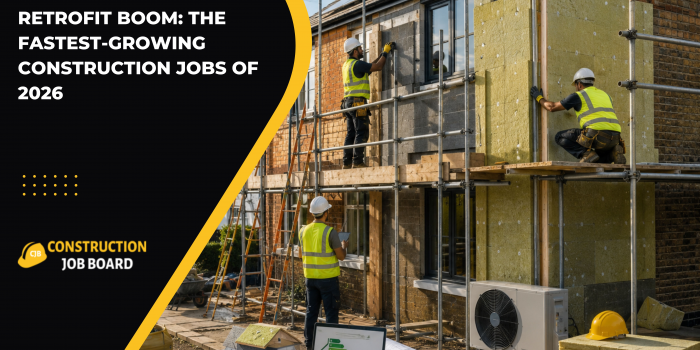
Retrofit is particularly important because improving existing buildings requires skilled workers, project managers, surveyors, engineers and specialist contractors.
How does construction contribute to public services?
Many public services depend on construction.
Schools need classrooms.
Hospitals need treatment facilities.
Police and emergency services need operational buildings.
Local authorities need public infrastructure.
Universities need campuses.
Transport authorities need stations and infrastructure.
Construction therefore supports public services both through new facilities and through maintenance and refurbishment.
A construction project may appear to be a physical asset, but its ultimate purpose can be to provide a service to the public.
What happens to the economy when construction slows down?
A construction slowdown can have wider consequences.
If fewer projects are commissioned, demand can fall for:
- Contractors
- Subcontractors
- Materials
- Equipment
- Transport
- Professional services
- Construction workers
Developers may delay projects.
Suppliers may receive fewer orders.
Businesses connected to construction may experience lower revenues.
Employment opportunities can also become more competitive.
This is why construction is often considered an important indicator of broader economic activity.
However, the impact varies depending on which construction sectors are slowing and which continue to grow.
Is construction important for the UK's future economic growth?
Yes.
The UK will continue to require housing, infrastructure, energy systems, transport improvements, public buildings and maintenance.
The challenge is not simply building more.
The industry also needs to improve productivity, address skills shortages, adopt new technologies and deliver projects more efficiently.
The combination of planned infrastructure investment, housing requirements, maintenance needs and technological change creates a long-term role for construction within the UK economy.
What does the future of the UK construction industry look like?
The future is likely to be more diverse and technology-driven than traditional perceptions of construction suggest.
Future demand is likely to come from a combination of:
Infrastructure: transport, energy, utilities and major public projects.
Housing: new homes and housing-related development.
Repair and maintenance: maintaining and upgrading existing buildings.
Regeneration: transforming city centres and regional economies.
Sustainability: improving energy performance and reducing environmental impact.
Technology: BIM, AI, automation, digital twins and data-driven construction.
Skills: replacing experienced workers and developing new technical capabilities.
CITB's current workforce outlook expects continued workforce requirements through 2030, while the government's infrastructure pipeline demonstrates the scale of planned investment.
This suggests that construction will remain an important part of the UK's economic infrastructure.
What does the construction industry's economic importance mean for jobseekers?
For someone looking for construction jobs, the industry's economic importance provides useful context.
Construction careers are connected to much more than individual building projects.
A job may be supported by:
- Housing demand
- Infrastructure investment
- Regional regeneration
- Commercial development
- Building maintenance
- Public-sector investment
- Energy improvements
- Technology adoption
Jobseekers should therefore consider which sectors are likely to require their skills.
For example, civil engineering skills may be particularly relevant to infrastructure.
Electrical and mechanical skills can be valuable across both construction and building services.
Quantity surveyors and estimators can work across many project types.
Site managers and project managers can move between sectors depending on experience.
Understanding the economic forces behind construction can therefore help workers make better career decisions.
Why does construction matter even when the economy is uncertain?
Construction does not operate independently of the wider economy.
Interest rates, inflation, business confidence and government spending can all influence construction demand.
But construction also provides essential services and infrastructure that cannot simply be ignored indefinitely.
Buildings need maintenance.
Transport networks need investment.
Homes need to be built.
Energy infrastructure needs improvement.
Public facilities need to be upgraded.
This creates a degree of long-term structural demand even when individual construction markets experience downturns.
So, why is the UK construction industry important?
The UK construction industry is important because it creates jobs, builds and maintains homes and infrastructure, supports thousands of businesses, develops skilled workers and provides the physical foundations on which other parts of the economy depend.
Its economic contribution extends from the construction worker on site to the manufacturer producing materials, the engineer designing infrastructure, the surveyor managing costs, the transport company moving equipment and the local business benefiting from increased activity.
The industry's future is also closely connected to some of the UK's biggest economic priorities: housing, infrastructure, regeneration, energy efficiency, sustainability and technological development.
With hundreds of major projects in the national infrastructure pipeline and substantial future workforce requirements, construction is likely to remain a strategically important UK industry.
For jobseekers, this means construction should be viewed not simply as a source of individual jobs, but as a broad employment ecosystem containing opportunities across skilled trades, engineering, surveying, technology, project management and construction leadership.
Frequently Asked Questions
Why is the construction industry important to the UK economy?
Construction is important because it creates employment, builds and maintains homes and infrastructure, supports businesses and supply chains, and provides facilities needed by industries and public services.
How many people are needed in UK construction?
CITB estimates that the UK construction industry will require an average of approximately 41,200 additional workers each year between 2026 and 2030 when growth and replacement demand are considered.
How does construction create jobs?
Construction creates direct employment for tradespeople, engineers, managers and professional workers while also supporting indirect jobs in manufacturing, transport, equipment, professional services and other parts of the supply chain.
Why is infrastructure important to construction?
Infrastructure projects such as railways, roads, energy systems and utilities require large multidisciplinary construction teams and can create long-term employment across contractors and suppliers.
Does construction help local economies?
Yes. Construction projects can create local employment, increase demand for suppliers and services, support regeneration and generate economic activity around development sites.
Is repair and maintenance part of the construction industry?
Yes. Repair and maintenance is a major component of construction activity and includes the upkeep, refurbishment and improvement of existing buildings and infrastructure.
Does construction support apprenticeships?
Yes. Construction offers apprenticeship routes into occupations including bricklaying, carpentry, electrical work, civil engineering and site management.
Will technology reduce construction jobs?
Technology is likely to change the skills required in construction, but the continued need for buildings and infrastructure means the industry will still require workers. Digital construction skills are likely to become increasingly important.
Which construction jobs will be important in the future?
Future demand is likely to include skilled trades, civil engineers, quantity surveyors, project managers, site managers, digital construction specialists, building services professionals and sustainability-related roles.
Is construction important outside London?
Yes. Construction activity and investment are spread across the UK, with major development and infrastructure programmes also taking place in cities and regions including Manchester, Birmingham, Leeds, Liverpool, Sheffield and Newcastle.
Conclusion
The UK construction industry is economically important because it connects employment, housing, infrastructure, business investment, public services, regional development and skills.
Its influence extends far beyond construction sites.
Every new building requires a supply chain. Every major infrastructure project requires a workforce. Every existing building requires maintenance. Every growing community needs homes, transport and public facilities.
The industry is also changing.
Digital technology, sustainability, infrastructure investment and changing workforce requirements are creating new opportunities alongside traditional construction careers.
For anyone researching construction jobs UK, understanding this wider economic picture can help explain why the sector remains strategically important and why construction careers continue to evolve.