Related Blogs
-

-
What Qualifications Do You Need to Work in Construction in the UK?
-
Are Construction Jobs Dangerous in the UK? The Risks, Safety Rules and Worker Protections
-

-

-

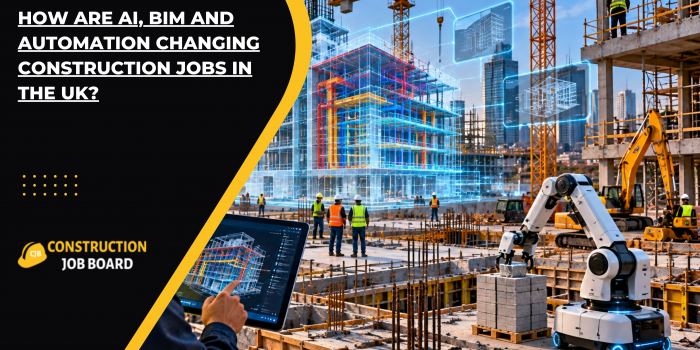
Artificial intelligence (AI), Building Information Modelling (BIM), drones and automation are changing how construction projects are designed, planned, monitored and delivered in the UK. These technologies help construction teams analyse information, coordinate designs, monitor progress and identify potential problems earlier.
For construction professionals, the change creates opportunities to develop digital skills alongside traditional industry knowledge. Site managers may use digital reporting tools, quantity surveyors may analyse project data, engineers may work with digital models, and surveyors may use drone imagery to assess sites.
However, technology is not replacing every construction role. Practical skills, technical judgement, communication, safety awareness and project experience remain important. The strongest career opportunities are often found where construction knowledge and digital capability work together.
CITB's Industry Picture 2026 highlights the importance of modernising construction practices and making better use of technology to address productivity and workforce challenges. Source: CITB — The Industry Picture.
AI can help construction teams process information, identify patterns and support decisions. Its usefulness depends on the quality of the available data, the task being performed and appropriate human oversight.
Potential applications include:
These applications do not all have the same level of adoption. Some are already used in particular organisations, while others remain experimental or depend on project-specific systems.
AI outputs can be incomplete or incorrect. Construction professionals must check important information, particularly when it affects structural design, contractual decisions, costs or health and safety.
AI-related skills may be relevant to construction project managers, estimators, quantity surveyors, planners, engineers, design professionals and digital construction specialists.
For example, a planner might use an AI-enabled tool to help review project schedules. The planner would still need to understand dependencies, contractor availability, site constraints and the practical consequences of a proposed change.
Similarly, an estimator could use digital tools to organise project information, but must still check quantities, specifications, assumptions and current costs.
The career advantage comes from applying technology accurately to real construction problems—not simply knowing how to use a chatbot.
Building Information Modelling (BIM) is a collaborative approach to managing information about buildings and infrastructure throughout their lifecycle. BIM can include digital models, asset information and structured data used by designers, contractors, clients and facilities teams.
It is not simply a three-dimensional drawing. Effective BIM workflows help project teams coordinate information, understand design relationships and reduce avoidable clashes or misunderstandings.
The UK BIM Framework provides guidance on information management aligned with the ISO 19650 series of standards. Source: UK BIM Framework.
BIM can support activities such as:
BIM-related work can be found in roles such as:
The software and qualification requirements differ by employer. Candidates should read vacancies carefully and identify which tools, information-management standards and practical skills are actually requested.
Drones and automated equipment can help construction teams collect information, monitor work and complete some tasks more efficiently.
Drones may be used for aerial photography, topographical surveys, progress monitoring and site inspections where the operation is appropriate and authorised. Their outputs can help teams compare site conditions over time and communicate progress.
Automation can include machine-control systems, robotic equipment, automated manufacturing processes and technologies that support repetitive or precision-based work.
Examples include:
These technologies do not remove the need for competent operators, accurate survey data, safe working practices or suitable supervision. Drone operations must comply with applicable aviation rules, and machinery must be used by appropriately trained personnel.
They may suit people who enjoy combining practical construction knowledge with technology. Relevant career areas include surveying, site engineering, plant operations, digital construction and technical support.
A worker does not necessarily need to become a software developer to benefit from these changes. Understanding how digital information is collected, checked and used can be valuable in many construction occupations.
AI and automation may change individual tasks, but it is not accurate to assume that they will eliminate construction work as a whole.
Construction projects require physical work, site-specific judgement, coordination between contractors, compliance with regulations and responses to conditions that change throughout a project.
Some repetitive administrative or data-processing tasks may become more automated. Other responsibilities may shift towards checking digital outputs, managing systems and making decisions based on information.
The likely effect will differ by occupation and employer. A design team may use automation to speed up repetitive modelling, while still requiring professionals to validate the design. A site team may use digital monitoring tools, while continuing to need competent workers to perform and supervise construction activities.
CITB's workforce research highlights the wider challenge of developing skills and improving productivity across the industry. Technology is one part of that picture; recruitment, training and retaining experienced workers remain important too. Source: CITB — Construction Workforce Outlook 2026–2030.
The most useful skills depend on your current role and the career you want to pursue. A practical starting point is to identify technologies that appear repeatedly in vacancies for that occupation.
|
Skill |
Potential construction applications |
|
BIM and digital modelling |
Design coordination and model-based project delivery |
|
Spreadsheet and data analysis |
Cost tracking, estimates and progress reporting |
|
Project management software |
Schedules, task coordination and project updates |
|
Digital site reporting |
Inspections, records and progress monitoring |
|
Drone and survey data |
Site measurement, mapping and monitoring |
|
AI literacy |
Reviewing information, automating suitable tasks and checking outputs |
|
Information management |
Maintaining accurate, consistent project information |
You do not need to learn every tool at once. Start with the technology most relevant to your current work, then build transferable skills in data quality, communication, problem-solving and digital collaboration.
CITB's research on construction's digital future also emphasises the importance of broader digital competencies and the ability to adapt as technologies evolve.
Experienced workers can build on their existing industry knowledge rather than starting again in a completely new field.
A site manager, for example, already understands sequencing, subcontractor coordination, site constraints and safety procedures. Learning digital planning and reporting tools may help them apply that knowledge in a more data-driven environment.
A quantity surveyor may develop stronger spreadsheet and data-analysis skills. An engineer may explore BIM coordination or digital design workflows. A surveyor may investigate digital mapping and drone-derived data.
A practical transition plan is to:
Employers may value demonstrable ability more than a long list of software courses. Training should be selected to meet real job requirements.
For employers, adopting technology involves more than buying software or equipment. Teams need suitable training, reliable information, clear processes and an understanding of how a tool fits into existing work.
For jobseekers, digital construction offers a reason to keep learning throughout a career. Traditional construction knowledge remains useful, but the ability to work with digital information may broaden the range of roles available.
The industry is unlikely to adopt every technology at the same speed. Larger projects and organisations may have dedicated digital teams, while smaller firms may adopt tools gradually according to cost, project needs and available expertise.
Candidates should therefore avoid assuming that every employer requires advanced AI or BIM skills. Check actual vacancies and prioritise the skills most relevant to your chosen occupation.
AI, BIM, drones and automation are influencing construction design, planning, surveying, reporting and project delivery. They can improve coordination and support decision-making, but their value depends on reliable data, competent users and appropriate oversight.
Construction professionals can prepare by combining existing industry experience with relevant digital skills. BIM may be useful for design and coordination roles, data analysis for commercial and planning work, and digital surveying tools for site-based technical careers.
The most effective approach is to follow employer requirements, learn technologies relevant to your role and continue strengthening practical judgement, communication and safety awareness.
AI can support planning, document review, cost analysis and selected monitoring tasks. Its impact varies by employer and application, and important outputs must be checked by qualified professionals.
Building Information Modelling is a collaborative method for managing digital information about buildings and infrastructure. It can support design coordination, construction planning and information management throughout an asset's lifecycle.
BIM may be used by BIM technicians, coordinators and managers, as well as architects, engineers, quantity surveyors and digital construction professionals. Requirements depend on the employer and project.
AI may automate some tasks and change how other work is performed, but construction still requires practical skills, technical judgement, coordination and competent supervision. The effect varies by occupation.
Useful skills may include BIM, spreadsheet and data analysis, project management software, digital site reporting, information management and AI literacy. The best starting point depends on the target job.
Yes. Experienced workers can build on their knowledge of construction processes by learning relevant digital tools. Site managers, surveyors, engineers and quantity surveyors may be able to apply their existing expertise in technology-supported roles.
Not necessarily. Some specialist software and AI engineering roles require advanced technical qualifications, but many construction roles use digital tools alongside industry experience, vocational training or role-specific learning.
CITB provides construction industry research and workforce information, while the UK BIM Framework provides guidance on information management and BIM standards. Employers and training providers may also offer role-specific courses.